


Last Updated on October 19, 2026 by Michael Motha
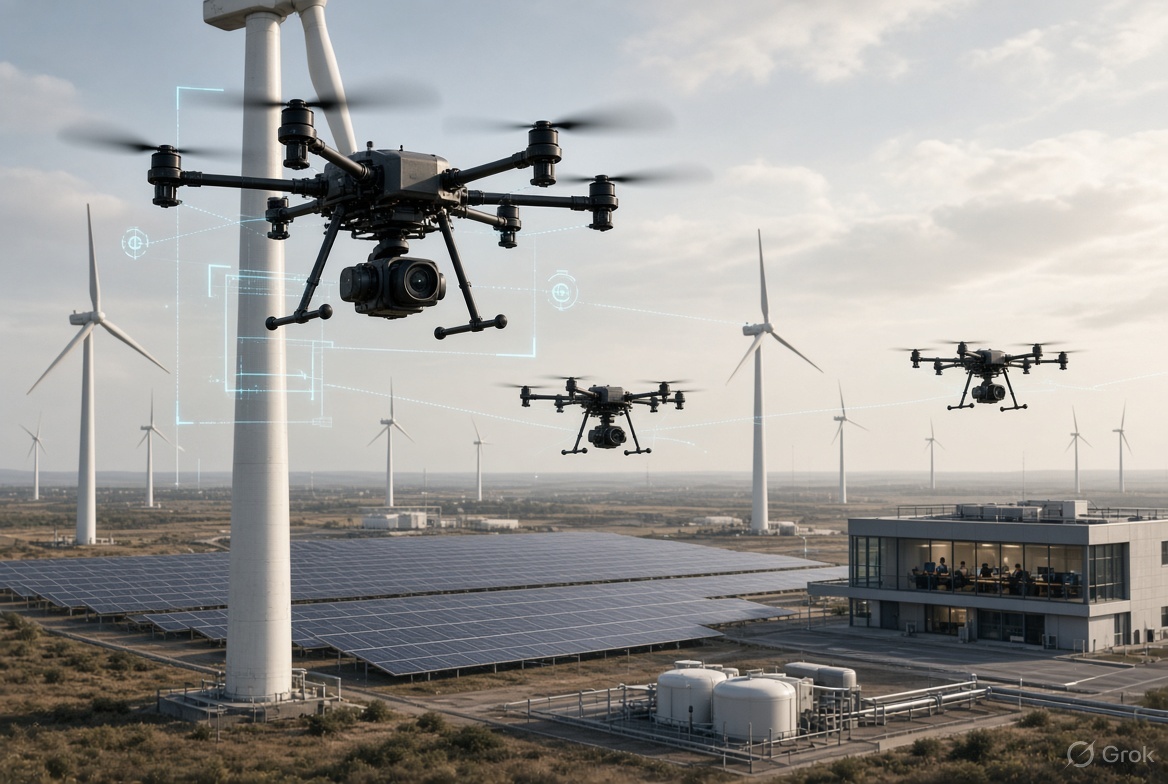
Drones are evolving from remotely controlled aircraft into intelligent systems that can interpret their surroundings, analyse information and coordinate with other technologies. The next stage of this transformation may depend less on a single drone’s camera or flight time and more on how effectively artificial intelligence connects aircraft, sensors, communications networks and human operators.
That shift is becoming increasingly important as drone technology expands into infrastructure inspection, emergency response, agriculture, logistics and public safety. In October 2026, reporting on AI software designed to connect different drone and sensor systems highlighted a broader challenge facing the industry: sophisticated aircraft are of limited value when their information remains trapped in separate systems. The commercial opportunity is to make those systems work together, while ensuring that people remain accountable for consequential decisions.
For businesses, this development creates a new technology market around intelligent drone software, edge computing, data platforms, fleet management and safety systems. It also raises difficult questions about reliability, privacy, cybersecurity and the limits of autonomous decision-making.
AI Drone Snapshot: Key Takeaways
- Artificial intelligence is helping drones interpret visual information, recognise patterns and support navigation.
- The next opportunity is coordinated intelligence across aircraft, sensors and enterprise software.
- Local processing can help drones respond quickly when cloud connectivity is unavailable or delayed.
- Agriculture, utilities, construction, logistics and emergency services offer potential commercial applications.
- Safety testing, cybersecurity, privacy and aviation rules remain essential.
- AI should support responsible operations, not eliminate human accountability.
Why Drone Technology Is Moving Beyond Remote Control
Traditional drones rely heavily on a human pilot to interpret camera feeds, manage the flight and decide what to inspect. That approach works for many tasks, but it becomes harder to scale when a mission covers a large area or involves multiple aircraft.
AI can automate selected parts of this workload. Computer vision can identify visible features in imagery, machine-learning models can flag unusual patterns, and onboard software can help maintain a planned route. Depending on the system, AI may also help prioritise the information that a human operator needs to review.
The important distinction is that these capabilities do not automatically make a drone fully autonomous. A system that identifies a damaged roof tile, for example, performs a different task from one that independently chooses where to fly in crowded airspace. Each capability requires its own testing, safeguards and operating permissions.
The emerging opportunity lies in combining specialised functions into a dependable workflow. A drone could collect imagery, flag a suspected problem, attach location information, send the result to an inspection platform and allow a qualified person to decide what action is required.
That workflow can be more valuable than simply capturing more photographs.
The Real Breakthrough Is Coordination Between Systems
A drone fleet may include aircraft from different manufacturers, cameras with different capabilities, mapping tools, communications equipment and software used by several departments. If those components cannot exchange information effectively, operators may have to manage separate dashboards and manually reconcile results.
AI-supported coordination aims to reduce that fragmentation.
A shared software layer could combine sensor information, show where each aircraft is operating, organise inspection results and highlight conflicts or unusual conditions for human review. In suitable applications, automated systems may also recommend task assignments or changes to a mission plan.
This is a broader systems challenge, not simply a drone-design problem.
Recent reporting from Reuters on October 8, 2026, described a Dutch software company’s effort to connect radar, sensors and drone systems through AI-assisted coordination. Although the reported deployment involved defence, the underlying interoperability problem also matters to civilian drone operators: separate technologies need reliable ways to exchange information and present it in a useful form.
Civilian applications must be evaluated on their own merits, regulations and safety requirements. Still, the general lesson is clear: the usefulness of connected aircraft depends on the quality of the software and information infrastructure around them.
Computer Vision Is Turning Drone Footage Into Useful Information
Drones can capture large quantities of visual data, but collecting images is only the first step. Someone still needs to identify what matters.
Computer vision can help analyse images for patterns such as visible cracks, damaged equipment, standing water, crop stress or changes between inspections. Depending on the environment and the model’s accuracy, the system may flag areas for closer examination instead of requiring an operator to review every image manually.
For utilities, this could help prioritise inspections of power infrastructure. Construction teams could compare site imagery over time. Farmers could use aerial observations to identify areas that warrant further investigation. Emergency teams could use imagery to build a clearer picture of damage after a storm.
However, an AI-generated flag should not automatically be treated as a confirmed diagnosis. Shadows, weather, camera angle, image quality and unfamiliar conditions can lead to false positives or missed problems.
The strongest approach combines automated screening with human verification, documented confidence limits and a clear process for correcting errors.
TechKip’s analysis of AI world models and physical intelligence explores the broader challenge of helping AI systems represent and reason about the physical world. For drones, this remains an important frontier: recognising an object in a photograph is not the same as understanding its movement, context or potential risk.
Edge AI Helps Drones Make Faster Decisions
Many AI applications depend on cloud computing, but a drone cannot assume that a high-quality internet connection will always be available. Remote sites, industrial facilities, disaster zones and areas with poor coverage can make continuous connectivity difficult.
Edge AI addresses part of this problem by processing selected information on the aircraft or on nearby computing hardware. A drone may be able to detect an obstacle, assess an image or identify a change without sending every frame to a distant server.
This can reduce communication demands and support quicker responses. It can also help limit the amount of raw footage that must be transmitted, although privacy and security still depend on how the system is designed.
TechKip’s coverage of on-device AI in smartphones explains the same underlying shift toward processing information locally. In drones, the stakes can be different because processing delays or incorrect outputs may affect a moving aircraft or people nearby.
Edge processing also has limits. Small aircraft have constraints involving computing power, battery consumption, heat and payload weight. Complex models may need to be simplified, while some analysis can be reserved for more powerful ground systems.
The practical goal is not to put every AI capability onboard. It is to decide which decisions must happen locally, which tasks can wait for a network connection and which outcomes require human approval.
BVLOS Operations Make Reliable AI More Important
Beyond Visual Line of Sight, or BVLOS, operations allow a drone to fly beyond the pilot’s direct visual range when the operation is authorised under applicable rules. These missions can make long-distance inspection and some delivery models more practical, but they also increase the importance of dependable navigation, communications, airspace awareness and contingency planning.
The US Federal Aviation Administration provides information on advanced drone operations and traffic management, including the role of unmanned aircraft traffic-management concepts in supporting operations beyond the pilot’s direct visual range.
AI can assist with analysing sensor inputs, monitoring system status and presenting potential conflicts to operators. Yet an AI model alone cannot guarantee safe BVLOS flight. Safety depends on the entire system, including aircraft design, communications, procedures, risk assessment, operating permissions and the ability to handle failures.
For businesses considering BVLOS services, the question should therefore be broader than whether a drone can fly autonomously. They need to understand how the complete operation is monitored, what happens if communications fail, how unexpected conditions are handled and who has authority to intervene.
That systems-level approach is likely to determine which applications can move from limited trials to dependable services.
Commercial Opportunities Extend Beyond Delivery
Drone delivery attracts considerable attention, but AI-enabled inspection and monitoring may be equally important commercial markets.
Energy providers, construction companies, agricultural businesses, insurers and logistics operators all manage assets or environments that can be difficult to inspect manually. Drones can collect data over large areas, while AI can help organise that information and identify locations that deserve closer attention.
In agriculture, image analysis could help farmers investigate crop variability or potential irrigation problems. In construction, automated comparisons between site images could help project managers track visible changes. In insurance, aerial imagery could support preliminary damage assessments after severe weather, subject to appropriate verification and privacy safeguards.
Delivery is another opportunity. TechKip’s earlier coverage of autonomous delivery drones and the future of logistics examines how autonomous aircraft could support time-sensitive shipments. AI coordination may help operators manage schedules, review operational data and allocate tasks, although commercial viability still depends on payload, range, safety, cost and local regulations.
For businesses, the most promising use case is not necessarily the one with the most advanced AI. It is the one where better information produces a measurable improvement in cost, reliability, response time or safety.
Digital Twins Could Give Drone Data More Business Value
A drone inspection is often only one stage of a much larger process. The collected information must be compared with previous observations, associated with the correct asset and delivered to the people responsible for maintenance or planning.
Digital twins can help connect those activities. A digital twin is a digital representation of a physical asset, process or system that can be updated with relevant information. Drone imagery and sensor measurements may contribute to that representation, depending on the application.
For example, a facilities team could use drone imagery to update a model of a building exterior. An energy operator might compare inspection findings against the location and maintenance history of equipment. A construction manager could review aerial observations alongside project plans.
TechKip’s article on AI digital twins and the future of work explores the wider potential of digital representations and AI. In industrial environments, the more relevant opportunity is connecting observations from the physical world with records and decisions in business systems.
These applications require accurate data, consistent asset identification and a process for validating changes. A convincing visual model is not necessarily an accurate operational record.
Cloud Platforms Turn Individual Flights Into Enterprise Intelligence
Local AI processing can help a drone respond during a mission, but organisations also need to store results, compare historical data, manage permissions and coordinate teams across multiple locations.
Cloud systems can support those longer-running tasks. They may combine imagery from multiple flights, keep inspection records, provide dashboards and make results available to authorised employees. Organisations can then connect findings to maintenance systems, geographic information systems or other business applications.
TechKip’s guide to cloud data platforms for enterprise analytics explores the infrastructure used to turn distributed information into business insight. For drone operators, the challenge is to build a data pipeline that remains secure, manageable and cost-effective as the number of aircraft and volume of information grow.
Not every image needs to be uploaded at full resolution, and not every AI model needs to run continuously. Selecting what to process onboard, what to transmit and what to retain can help control bandwidth and storage costs.
Companies should also consider data ownership, retention periods, access permissions and vendor portability before committing to a platform.
Safety, Privacy and Cybersecurity Cannot Be Afterthoughts
AI-enabled drones combine several technologies that can each introduce risk: aircraft control, computer vision, communications, cloud software and automated decision-making.
An incorrect model output could lead to a missed defect or an unnecessary alert. A software vulnerability could expose sensitive imagery or operational information. A communications failure could interrupt a mission. Poorly managed access controls could allow an unauthorised person to view or change flight-related data.
The National Institute of Standards and Technology’s AI Risk Management Framework offers a voluntary approach to managing AI risks across the design, development, deployment and use of AI systems. Its emphasis on reliability, safety, security, transparency and accountability is relevant to organisations deploying AI-enabled drone services.
Privacy deserves similar attention. A drone may record homes, workers, vehicles or members of the public who are not part of the intended task. Operators should collect only the information they need, restrict access, establish retention policies and comply with applicable privacy and aviation requirements.
Human oversight must also be meaningful. An operator needs enough information and authority to challenge an AI recommendation, pause an operation or initiate an established fallback procedure. Simply placing a person in front of a dashboard does not guarantee effective supervision.
What Businesses Should Evaluate Before Investing
Organisations exploring AI-enabled drones should start with a specific operational problem rather than purchasing technology because it appears innovative.
A useful assessment includes several questions:
- Business value: What measurable cost, time, quality or safety improvement is expected?
- Technical fit: Can the aircraft, sensors and AI models operate reliably in the intended environment?
- Data quality: Are images and sensor readings accurate enough for the intended decision?
- Connectivity: Which functions must work without a reliable internet connection?
- Compliance: What permissions, training and operating procedures are required?
- Security: How are aircraft, communications, accounts and stored data protected?
- Human responsibility: Who reviews uncertain results and makes consequential decisions?
- Total cost: What will aircraft, maintenance, software, connectivity, training and data storage cost over time?
A controlled pilot project can test these assumptions before a company expands its fleet. It should include representative operating conditions, documented performance measures and procedures for recording failures—not just successful demonstrations.
Industry Outlook
AI-enabled drones are moving toward a more integrated model in which aircraft, software, sensors and enterprise systems contribute to a shared operational picture. Progress will not be uniform: a crop-monitoring drone, a warehouse inspection system and an aircraft operating beyond visual line of sight have different technical and regulatory requirements.
Over time, improvements in computer vision, edge processing and data integration could make drone services more useful to businesses that need regular observations of physical assets. Yet better algorithms will not remove the need for dependable aircraft, reliable communications, trained operators and sound operating procedures.
The most commercially durable opportunities are likely to come from specific workflows with clear benefits. Providers that can demonstrate dependable performance, protect sensitive data and integrate results into customers’ existing systems may be better positioned than companies selling autonomy as a feature without demonstrating its practical value.
TechKip Perspective
The next phase of drone innovation is not simply about making aircraft fly without a pilot controlling every movement. It is about building systems that can collect information, interpret it responsibly and help people make better decisions.
That creates opportunities across AI software, sensors, edge computing, cloud infrastructure and digital twins. It also changes how businesses should evaluate drone investments: the value lies not only in the aircraft but in the quality of the complete workflow.
Autonomy should be introduced according to the risk and requirements of each application. Routine image analysis may be suitable for substantial automation, while safety-critical actions need stricter validation, defined limits and appropriate human authority.
The companies that succeed will be those that combine useful intelligence with operational reliability. In this market, trust is not an optional feature added after development. It is part of the product.
Conclusion
AI is transforming drones from flying cameras into platforms for sensing, analysis and coordinated work. Computer vision can help identify patterns, edge processing can support timely decisions, and cloud platforms can turn flight data into information that businesses can use.
But the strongest results will come from combining those capabilities with reliable hardware, careful testing, privacy protections and accountable human oversight.
The long-term opportunity is larger than autonomous flight alone. It is the creation of intelligent aerial systems that connect physical environments with the digital tools used to inspect, maintain and manage them.
For businesses, the right question is no longer simply whether a drone can fly itself. It is whether an AI-enabled drone system can perform a clearly defined job safely, consistently and economically.
Frequently Asked Questions
What are AI-powered drones?
AI-powered drones use artificial intelligence to perform tasks such as analysing images, recognising objects, identifying patterns and supporting navigation or mission planning. The capabilities vary by system, and AI assistance does not automatically mean a drone is fully autonomous.
How are AI drones used in commercial industries?
Potential uses include infrastructure inspection, crop monitoring, construction progress tracking, environmental observation, preliminary damage assessment and logistics. Suitability depends on the operating environment, regulations and the reliability of the system.
What is the difference between an autonomous drone and an AI-powered drone?
An autonomous drone can perform some flight tasks with limited direct human control. An AI-powered drone uses AI for one or more functions, such as image analysis or navigation support. A drone may use AI without being authorised or technically capable of operating fully autonomously.
Can AI drones operate without an internet connection?
Some can perform selected onboard functions using edge processing, such as analysing sensor data or detecting obstacles. Other capabilities may depend on external connectivity. The exact limitations depend on the aircraft, software and operational design.
Are AI-powered drones safe?
They can support safer and more efficient operations when properly designed, tested and supervised, but they are not automatically safe. Hardware failures, inaccurate AI outputs, communications problems, cybersecurity weaknesses and human error must all be considered.
What is the future of AI drone technology?
Likely areas of development include more capable onboard processing, improved image analysis, better fleet coordination and deeper integration with cloud platforms and digital twins. Adoption will depend on measurable benefits, safety, cost and regulatory approval.
Editorial note: Capabilities and adoption vary by manufacturer, application and jurisdiction. Prospective operators should verify current requirements with the relevant aviation authority before conducting advanced operations.