


Last Updated on April 29, 2026 by admin
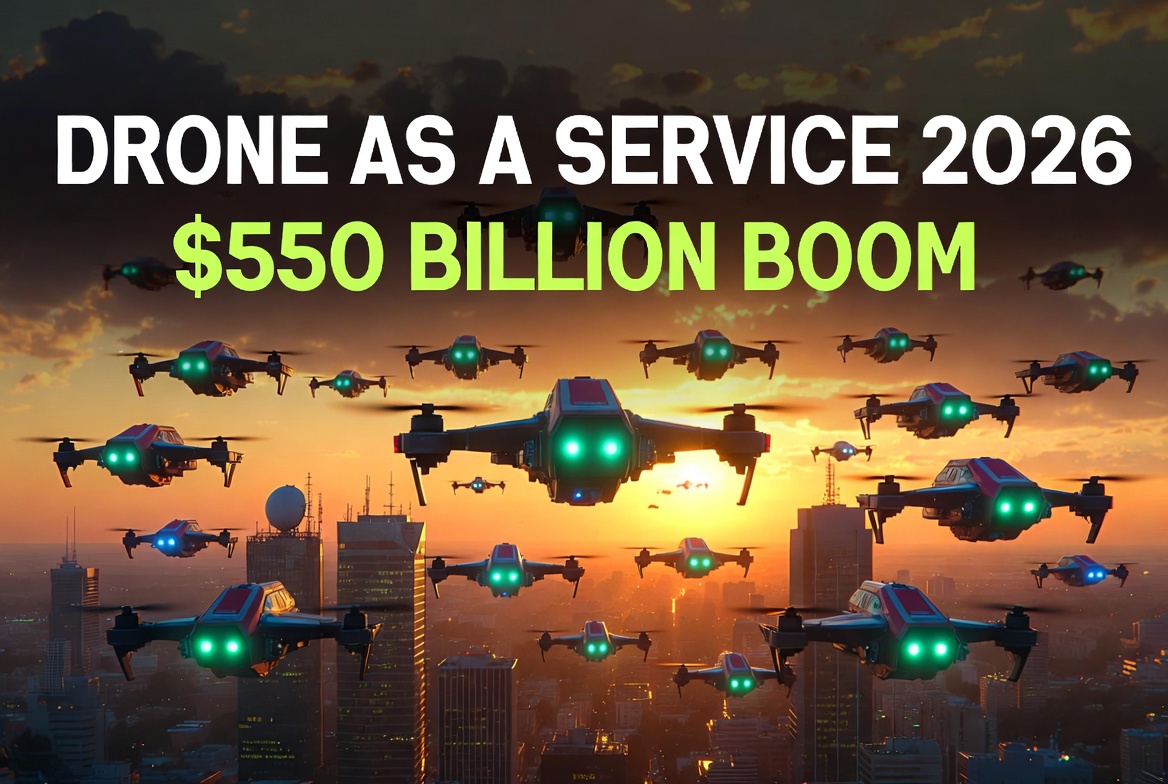
The global drone industry has entered a transformative phase in 2026. Once limited to recreational use and basic surveillance, drones have evolved into sophisticated platforms offered through Drones-as-a-Service (DaaS) — a flexible, subscription-based model that allows businesses, governments, and militaries to access advanced autonomous drone capabilities without the burden of owning and maintaining hardware fleets.
Industry forecasts now project the global DaaS market to grow from approximately $33.5 billion in 2025 to more than $550 billion by 2034, representing one of the most explosive opportunities in modern technology and defense. In April 2026, surging defense contracts, rapid AI advancements, and expanding commercial applications are driving unprecedented momentum. For more insights into emerging technologies shaping our future, visit the Techkip homepage.
The Explosive Growth of Drones-as-a-Service in 2026
Recent market analyses confirm that DaaS adoption is accelerating rapidly across defense, logistics, infrastructure inspection, agriculture, and emergency response sectors. Unlike traditional drone procurement, which demands heavy upfront investment in equipment, training, and maintenance, DaaS providers deliver complete solutions: aircraft, operators, data analytics, regulatory compliance, and continuous software updates on a pay-per-mission or subscription basis.
According to a recent Nasdaq report on DaaS market, the Drones-as-a-Service sector is positioned as defense’s next major growth engine, with strong tailwinds from both military and commercial demand.
This shift dramatically lowers barriers for small and medium enterprises while giving large organizations and governments the ability to scale operations instantly. North America continues to lead global adoption, but Europe and Asia-Pacific are catching up quickly as regulatory frameworks mature.
Defense Applications Driving the 2026 Surge
Geopolitical tensions have made drones indispensable on modern battlefields. Major joint exercises such as Balikatan 2026 between the United States and the Philippines have demonstrated the effectiveness of autonomous drone swarms and real-time intelligence platforms like the Ghost-X system.
As highlighted in Euronews drone technology analysis, drone technology evolves every three to six months, forcing traditional procurement models to adapt or risk obsolescence. DaaS solves this challenge by providing continuous access to the latest hardware and software without lengthy acquisition cycles.
The global military drone market is projected to nearly double to $98.2 billion by 2033. Through DaaS contracts, armed forces can rapidly deploy swarms for surveillance, electronic warfare, supply delivery, and target acquisition while reducing logistical overhead and maintenance costs. Several nations are now prioritizing service-based models to maintain technological superiority in contested environments.
Commercial and Logistics Breakthroughs
On the civilian front, major corporations are scaling drone delivery services at remarkable speed. Amazon has announced aggressive expansion of its Prime Air program in 2026, aiming to serve tens of millions of customers with sub-30-minute deliveries. Similar initiatives by Wing (Alphabet) and other providers are transforming last-mile logistics, medical supply chains, and emergency response operations.
Autonomous navigation powered by edge AI now enables reliable Beyond Visual Line of Sight (BVLOS) operations even in dense urban environments. This breakthrough has unlocked efficiency gains that were previously unimaginable, allowing drones to handle complex routes, avoid obstacles, and complete missions with minimal human intervention.
Technological Enablers Powering the DaaS Revolution
Several critical innovations are converging to fuel the 2026 boom:
- Edge AI and Swarm Intelligence: Modern drones can process data onboard and make real-time decisions, enabling coordinated swarm operations without constant cloud connectivity.
- Advanced Energy Systems: Improvements in hydrogen fuel cells and next-generation batteries have significantly extended flight times, making heavy-payload and long-range missions commercially viable.
- Regulatory Progress: Updated FAA rules, expanded BVLOS waivers, and international harmonization efforts are removing previous operational bottlenecks.
- Counter-Drone and Cybersecurity Solutions: As drone usage grows, integrated security systems are evolving in parallel to protect critical infrastructure and military assets.
The integration of edge AI in modern drones highlights why our Artificial Intelligence category continues to deliver critical forward-looking analysis.
Challenges and Risks in the DaaS Landscape
Despite strong momentum, the sector faces notable challenges. Proliferation of counter-drone systems (C-UAS) is occurring almost as quickly as drone deployment itself. Cybersecurity vulnerabilities in swarm communications and data transmission remain serious concerns, particularly for defense applications. Privacy issues, airspace congestion in urban areas, and ethical questions around autonomous lethal systems continue to spark public debate.
Industry stakeholders are addressing these challenges through quantum-resistant encryption, advanced AI threat detection, and collaborative regulatory frameworks. Companies that successfully integrate robust security and ethical governance into their DaaS offerings are likely to gain significant competitive advantages.
What This Means for Businesses and Investors in 2026
For enterprises, adopting DaaS translates into dramatically lower capital expenditure, instant access to state-of-the-art technology, and unprecedented operational flexibility. Infrastructure companies now conduct bridge inspections, pipeline monitoring, and disaster assessments in hours rather than days, often at a fraction of traditional costs.
Readers can explore more coverage in the full Drones category on Techkip.
Investors have taken notice. Publicly traded DaaS providers and drone technology firms have attracted strong interest throughout 2026 as the recurring revenue nature of service contracts proves highly attractive compared to one-time hardware sales. The model also creates opportunities for smaller players to enter the market without massive manufacturing investments.
The Road Ahead for Drone as a Service
As 2026 progresses, experts anticipate further market consolidation, larger government DaaS contracts, and major breakthroughs in fully autonomous cargo delivery and urban air mobility. The convergence of artificial intelligence, advanced energy solutions, supportive regulations, and shifting procurement mindsets positions DaaS as one of the defining technology megatrends of the decade.
The traditional model of owning and maintaining individual drone fleets is rapidly becoming outdated. In its place emerges a dynamic, service-oriented ecosystem in the skies that promises to reshape industries, enhance national security, and create substantial economic value worldwide.
FAQ – Drone as a Service 2026
A: DaaS is a subscription or pay-per-use model where companies access advanced drone capabilities, data analytics, and operational support without purchasing or maintaining hardware themselves.
A: The global DaaS market is projected to grow from $33.5 billion in 2025 to over $550 billion by 2034, according to recent industry forecasts.
A: Defense and military applications currently lead, followed closely by logistics, infrastructure inspection, agriculture, and emergency services.
A: Lower costs, access to latest technology, reduced maintenance burden, regulatory compliance support, and greater operational scalability.
A: Stay updated with the latest developments by following Techkip for daily curated technology insights.
The Drones-as-a-Service revolution of 2026 is more than just a market trend — it represents a fundamental shift in how humanity utilizes aerial technology. With massive investment, rapid innovation, and growing real-world applications, DaaS stands poised to become one of the most impactful technological developments of the decade.


 market is exploding in 2026 with projections reaching $550 billion by 2034. Discover how AI-powered autonomous drones are transforming defense, logistics, and commercial operations.)