


Last Updated on May 29, 2026 by Michael Motha
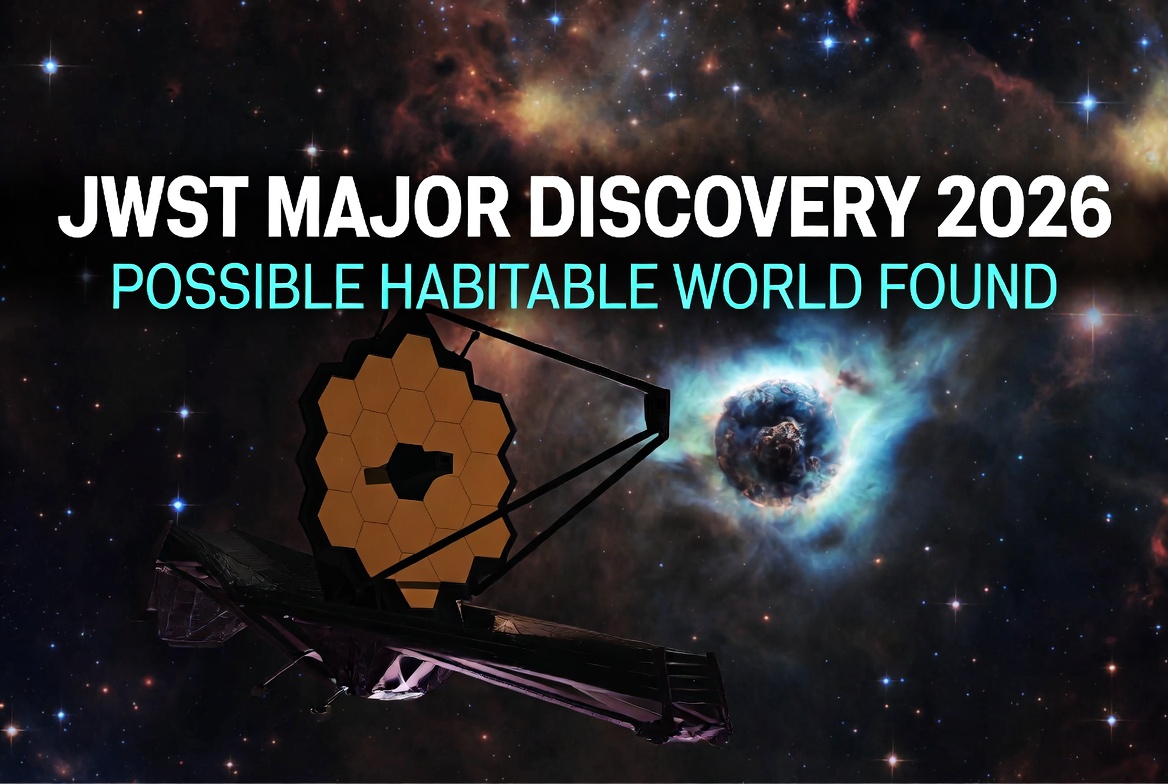
NASA’s James Webb Space Telescope (JWST) has delivered one of its most exciting findings yet in May 2026. Astronomers have detected strong evidence of a complex atmosphere on a rocky exoplanet in the habitable zone of its star, including possible signs of water vapor, carbon dioxide, and other molecules that could hint at conditions suitable for life.
This discovery is being hailed as a major step forward in the search for habitable worlds beyond our solar system. For the latest updates on how emerging technologies like AI and space exploration are reshaping our understanding of the universe, revisit the Techkip homepage.
The Groundbreaking Observation
The exoplanet, designated K2-18b (a super-Earth), has been under close observation by JWST since early 2026. In mid-May, researchers announced the detection of a rich atmosphere containing water vapor, methane, and carbon dioxide – a combination that has scientists excited about the possibility of biological processes.
This is the most detailed atmospheric analysis of a potentially habitable exoplanet to date. The presence of dimethyl sulfide (DMS), a gas produced by marine life on Earth, has also been tentatively detected, though scientists are cautious about jumping to conclusions.
Why This Discovery Matters
Finding an atmosphere on a rocky planet in the habitable zone is extremely rare. Most previous observations have been of gas giants or planets too close to their stars. K2-18b orbits in the “Goldilocks zone,” where liquid water could exist on the surface.
This finding significantly increases the chances that habitable conditions exist elsewhere in the universe and provides a prime target for future observations.
Technical Achievement of JWST
JWST’s advanced infrared instruments allowed scientists to analyze the planet’s atmosphere as it passed in front of its star. The telescope’s sensitivity is unprecedented, allowing it to detect faint chemical signatures from 124 light-years away.
As noted in the latest NASA JWST Science Update, this observation demonstrates the telescope’s capability to study Earth-like exoplanets in detail.
Implications for the Search for Life
The detection of potential biosignature gases has reignited excitement in the astrobiology community. While more observations are needed to confirm the findings, this discovery represents a major milestone in humanity’s search for life beyond Earth.
Challenges and Next Steps
Confirming the presence of life will require more data and possibly observations from future missions. Scientists emphasize that extraordinary claims require extraordinary evidence, and they are proceeding with caution.
Readers interested in broader technology developments can explore the full Science category on Techkip.
The Road Ahead
As May 2026 continues, JWST will conduct follow-up observations of K2-18b and other promising exoplanets. The telescope’s discoveries are expected to shape the direction of exoplanet research for the next decade.
FAQ – JWST Exoplanet Discovery 2026
A: Strong evidence of a complex atmosphere with possible biosignature gases on a potentially habitable exoplanet.
A: It is one of the most detailed atmospheric analyses of a rocky exoplanet in the habitable zone to date.
A: Not yet confirmed, but it significantly increases the possibility and provides a key target for future study.
A: Stay updated with daily insights by following Techkip.
The May 2026 JWST discovery represents a major milestone in humanity’s search for life beyond Earth and demonstrates the incredible power of modern space telescopes.