


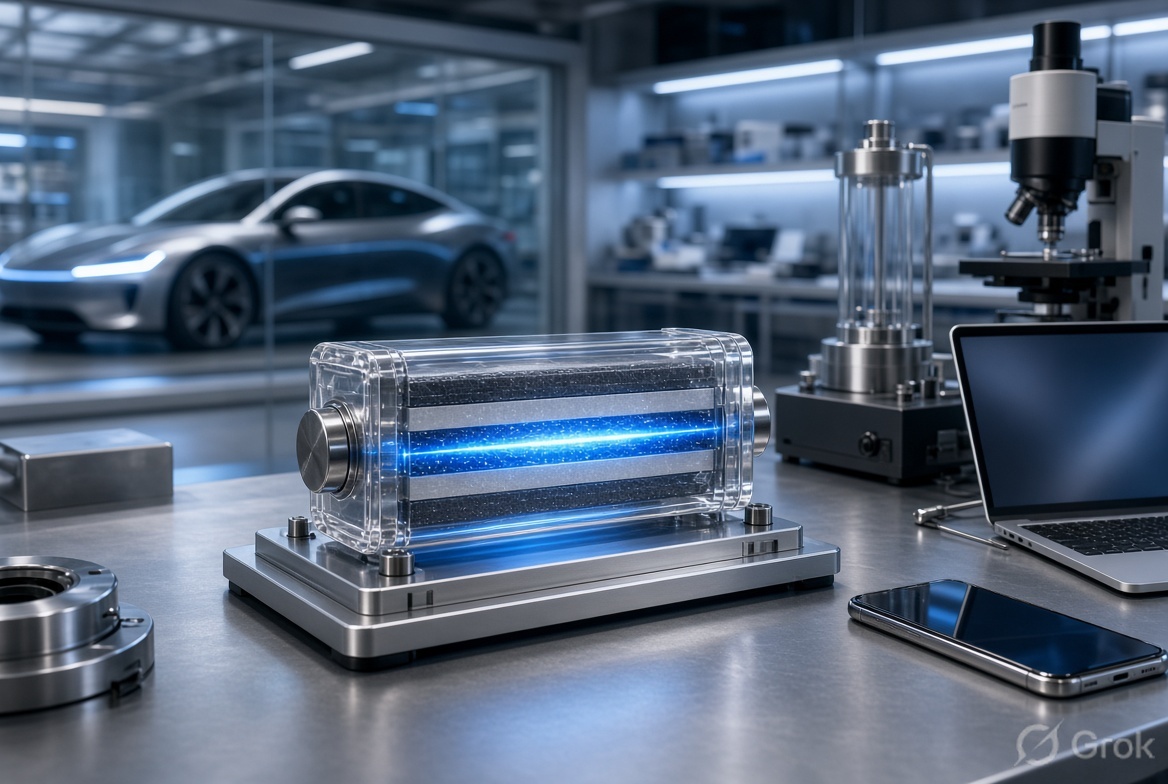
Last Updated on August 12, 2026 by Michael Motha
For more than three decades, lithium-ion batteries have quietly powered the digital revolution. They transformed smartphones from simple communication devices into pocket-sized computers, helped make laptops thinner and more capable, and enabled electric vehicles to move from experimental technology into mainstream transportation.
But conventional lithium-ion batteries are approaching a point where improving them further is becoming increasingly difficult.
Researchers and manufacturers are therefore looking beyond incremental improvements and exploring a fundamentally different architecture: the solid-state battery.
Instead of relying on a liquid or gel electrolyte to move ions between electrodes, solid-state batteries use a solid electrolyte. That seemingly simple change could have major consequences for energy density, safety, charging performance, battery packaging and eventually the design of electric vehicles and portable electronics.
The technology is still facing substantial manufacturing and cost challenges. Yet major automotive and battery companies are investing heavily in the field, while pilot production and commercialisation programmes are beginning to move the technology beyond laboratory research. Toyota has targeted 2027–28 for commercialisation of all-solid-state batteries, while QuantumScape has been developing an automated pilot production line for its technology.
The question is no longer whether solid-state batteries are scientifically interesting.
The bigger question is whether manufacturers can produce them reliably, affordably and at enormous scale.
Science Snapshot: Key Takeaways
- Solid-state batteries replace conventional liquid electrolytes with solid materials.
- They could potentially deliver higher energy density than today’s lithium-ion designs.
- Improved thermal stability could make some solid-state architectures safer.
- Faster charging is one of the technology’s most attractive potential advantages.
- Electric vehicles could benefit from lighter battery packs and longer driving ranges.
- Smartphones, wearables and other compact electronics could eventually benefit from higher energy density.
- Manufacturing consistency, cost and long-term durability remain major obstacles.
- Commercialisation is beginning, but mass-market adoption is not guaranteed.
Why Batteries Are Becoming the Next Technology Battleground
The next generation of technology will increasingly depend on how efficiently it can store and use energy.
Artificial intelligence, electric vehicles, robotics, drones, wearable devices and increasingly powerful smartphones all have one thing in common: they require substantial computing power without allowing battery limitations to compromise the user experience.
That makes battery technology a strategic component of innovation rather than simply a hardware specification.
A smartphone may have an extremely capable processor, but its usefulness is limited if that processor rapidly drains the battery. An electric vehicle may have an advanced motor, but its practicality depends heavily on how much energy can be stored without making the vehicle excessively heavy.
Battery innovation is already becoming critical to the evolution of smartphones and other portable devices. TechKip recently explored how on-device AI is redefining smartphones without sending data to the cloud, a trend that also increases the importance of efficient, high-density battery technology.
Solid-state technology is attracting attention because it potentially addresses several of these limitations at the same time.
The technology is not simply about putting more energy into a battery.
It is about changing the architecture of the battery itself.
What Makes Solid-State Batteries Different?
A conventional lithium-ion battery contains a liquid electrolyte that allows lithium ions to move between the cathode and anode during charging and discharging.
Solid-state batteries replace that liquid electrolyte with a solid material.
The change creates new possibilities for battery design.
A solid electrolyte can potentially reduce some of the safety concerns associated with flammable liquid electrolytes. It may also enable different electrode configurations, including lithium-metal anodes, that could substantially increase energy density.
Higher energy density means more stored energy for the same weight or volume.
For an electric vehicle, that could translate into greater driving range without requiring a significantly larger battery pack.
For a smartphone, it could mean longer battery life without making the device thicker.
The U.S. Department of Energy’s research into advanced battery technologies highlights the importance of solid-state approaches in improving performance, safety and manufacturing potential.
The importance of energy density is becoming even clearer as smartphones evolve into increasingly powerful computing platforms, as TechKip examined in The End of Apps? AI Phones in 2026 Are Changing Everything.
The underlying principle is straightforward: better batteries give engineers greater freedom to design better products.
Solid-State Batteries Could Change Electric Vehicles
Electric vehicles are perhaps the biggest potential market for solid-state batteries.
Today’s EV batteries already provide enough range for many consumers, but range anxiety, charging time, battery weight and long-term degradation remain important considerations.
A successful solid-state battery could address several of these issues simultaneously.
Higher energy density could allow manufacturers to build lighter battery packs while maintaining or increasing driving range.
Alternatively, manufacturers could keep battery size similar while providing significantly more usable energy.
Charging performance could also improve.
Some solid-state designs are being developed with the goal of enabling substantially faster charging than today’s conventional lithium-ion systems. Faster charging would make long-distance electric travel more convenient and could reduce one of the major psychological barriers to EV adoption.
Toyota has been working with Idemitsu on solid-electrolyte production and has described a development pathway targeting commercialisation of all-solid-state batteries for battery-electric vehicles in 2027–28.
The potential impact becomes even more interesting when viewed alongside other emerging energy-storage technologies. TechKip recently examined quantum batteries and their potential impact on electric vehicles and smartphones, offering another perspective on how researchers are rethinking energy storage.
However, solid-state batteries should not be treated as a guaranteed replacement for lithium-ion technology.
They must first demonstrate reliable performance across millions of cells and thousands of charging cycles.
Why Safety Could Be One of the Biggest Advantages
Battery safety is another major reason solid-state technology attracts attention.
Conventional lithium-ion batteries contain flammable electrolyte materials. Under certain conditions, physical damage, manufacturing defects or thermal runaway can result in fires.
Solid electrolytes could potentially reduce some of these risks because they do not behave like conventional liquid electrolytes.
However, “solid-state” does not automatically mean “fireproof.”
Battery safety depends on the complete cell architecture, materials, manufacturing quality, thermal management and operating conditions.
Different solid-state chemistries also have different characteristics.
Some use ceramic materials, while others rely on polymer or composite electrolytes.
Researchers therefore continue to investigate the relationship between material properties, interfaces and long-term stability.
The biggest opportunity may come from combining improved safety with higher energy density rather than treating either characteristic in isolation.
The Manufacturing Challenge
The science behind solid-state batteries is only half the problem.
The other half is manufacturing.
A battery that performs brilliantly inside a laboratory is not automatically suitable for mass production.
Automotive manufacturers need millions of cells with extremely consistent performance. Small manufacturing variations can become significant when multiplied across a huge production volume.
Solid-state batteries can introduce additional manufacturing complexity because the interfaces between solid materials must remain stable during repeated charging and discharging.
Production equipment may also need to operate under tightly controlled conditions.
QuantumScape’s automated Eagle Line illustrates the scale-up challenge. The company says the pilot production system is intended to produce cells for customer sampling, testing, technology demonstrations and product integration.
The scale-up challenge is illustrated by QuantumScape’s Eagle Line pilot production, which is designed to support the transition from laboratory development toward repeatable cell manufacturing.
This stage is crucial.
The industry needs to demonstrate not just that solid-state cells can work, but that they can be manufactured economically and consistently.
Cost Could Determine When Solid-State Batteries Go Mainstream
Even if solid-state batteries outperform lithium-ion technology, cost could determine how quickly consumers see them in everyday products.
New materials, specialised manufacturing equipment and lower initial production volumes can make emerging battery technologies expensive.
Automakers are therefore likely to introduce solid-state technology gradually.
Premium vehicles could receive the first-generation cells because customers in that segment may be willing to pay for longer range, faster charging or improved performance.
As production increases and manufacturing processes mature, costs could eventually decline.
This pattern has occurred repeatedly in technology.
New display technologies, semiconductor processes and camera systems often begin as premium features before moving into less expensive products.
Solid-state batteries could follow a similar path.
The key is achieving enough manufacturing scale to turn laboratory performance into commercially competitive economics.
Beyond Cars: Where Solid-State Batteries Could Go
Electric vehicles may become the headline application, but they are unlikely to be the only one.
Portable electronics could benefit significantly from higher energy density.
Smartphones could potentially become thinner while maintaining battery life, or they could retain their current form factors while lasting substantially longer between charges.
Laptops and tablets could similarly benefit from increased energy storage without requiring larger batteries.
Wearables represent another interesting application.
Smartwatches, smart glasses, wireless earbuds and other compact devices have extremely limited internal space.
A higher-energy-density battery could provide more operating time without increasing the size of the device.
The same shift toward compact, intelligent devices can be seen in wearable computing. TechKip recently examined how AI smart glasses could redefine the future of wearable computing, highlighting why smaller and more efficient power sources could become increasingly important.
Drones and robotics could also benefit.
For autonomous systems, every gram matters.
A lighter battery capable of storing more energy could increase flight time, payload capacity or operating range.
That could have implications far beyond consumer electronics.
Solid-State Batteries Could Also Change Device Design
Battery technology does not simply determine how long a device operates.
It can influence the shape of the device itself.
If manufacturers can store significantly more energy in the same physical space, designers gain additional flexibility.
A smartphone could use the freed-up space for cameras, sensors, cooling systems or other components.
An electric vehicle could potentially use a smaller battery pack to achieve the same range, freeing space for passengers or cargo.
A wearable device could become thinner without sacrificing operating time.
In other words, better batteries could become an enabling technology for entirely new product designs.
This is one reason battery breakthroughs can have an impact far beyond the energy sector.
The Sustainability Question
Solid-state batteries are often discussed primarily in terms of performance, but sustainability is becoming equally important.
The environmental impact of a battery depends on much more than how much energy it stores.
Raw materials, mining, manufacturing energy, transportation, battery lifespan, recycling and end-of-life processing all contribute to its overall footprint.
Recent research on solid-state battery design highlights the importance of considering sustainability during the development stage rather than attempting to address it only after commercialisation.
That means manufacturers will need to consider the complete lifecycle of solid-state batteries.
A battery that lasts longer could reduce replacement demand.
A battery that uses fewer problematic materials could reduce environmental pressure.
A battery that is easier to recycle could improve resource recovery.
The ideal next-generation battery therefore needs to be not only more powerful but also more sustainable.
The Battery Race Is Becoming a Technology Race
The competition surrounding batteries is increasingly extending beyond traditional automotive companies.
Automakers, semiconductor companies, chemical manufacturers, energy-storage companies and technology startups are all attempting to secure positions in the next generation of energy storage.
The reason is simple.
The company that develops a better battery may gain an advantage across multiple industries.
A breakthrough in energy density could influence electric vehicles.
A breakthrough in charging could change consumer electronics.
A breakthrough in manufacturing could reshape the economics of energy storage.
Battery advances will also influence the wider AI ecosystem, particularly as increasingly capable AI systems demand more computing power and energy. TechKip recently examined this broader transformation in AI Digital Employees Could Transform the Future of Work.
The battery race is therefore becoming part of the broader technology race.
What Still Needs to Be Solved
Solid-state batteries remain a developing technology, and several technical challenges must be addressed before mass adoption.
Long-term durability is one.
A battery may perform exceptionally during early testing but degrade differently after thousands of charging cycles.
Interface stability is another major issue.
The solid electrolyte must maintain effective contact with the electrodes as the battery repeatedly expands and contracts.
Manufacturing uniformity is equally important.
A successful battery design must work consistently across enormous production volumes rather than only under controlled laboratory conditions.
There is also no single solid-state battery design.
Different companies are pursuing different materials, architectures and manufacturing approaches.
That means the industry may eventually adopt several competing solutions rather than one universal chemistry.
Industry Outlook
The next phase of the solid-state battery industry will be defined by scale.
The science is increasingly mature enough to support pilot production and serious commercial programmes, but mass-market adoption will depend on manufacturing economics and long-term reliability.
Toyota’s planned 2027–28 commercialisation target is one of the clearest industry milestones, while QuantumScape’s pilot production efforts demonstrate how companies are attempting to bridge the gap between laboratory development and industrial manufacturing.
Recent research also reinforces the importance of designing sustainability into the technology from the beginning.
The winners in the solid-state battery race may therefore not necessarily be the companies with the highest laboratory energy-density figure.
They may be the companies that can combine performance, safety, longevity, manufacturability, affordability and sustainability.
Recent scientific research also highlights why sustainability cannot be treated as an afterthought, identifying materials, manufacturing processes and lifecycle considerations as important factors in the future development of solid-state batteries.
TechKip Perspective
Solid-state batteries have spent years being presented as the next big battery revolution.
That description may eventually prove correct, but the technology still has an important hurdle to clear: moving from impressive laboratory and pilot results to dependable mass production.
The most exciting possibility is not simply that an EV could travel farther.
It is that better batteries could give engineers freedom to rethink entire categories of technology.
Smartphones could become more powerful without sacrificing battery life. Wearables could become smaller. Drones could fly longer. Electric vehicles could become lighter and faster to recharge.
At TechKip, we believe the battery revolution will ultimately be measured not by one breakthrough specification but by how effectively new battery architectures improve everyday technology.
Solid-state batteries may not replace conventional lithium-ion cells overnight.
But if manufacturers solve the cost and production challenges, they could become one of the most important foundations of the next generation of connected devices and electric transportation.
Conclusion
The future of batteries is moving beyond simply increasing capacity.
Solid-state technology represents a fundamental attempt to redesign how energy is stored, with the potential to improve energy density, safety, charging performance and product design.
Electric vehicles are likely to be the most visible early application, but the implications extend to smartphones, laptops, wearables, drones and other compact electronics.
The road to mass adoption will not be easy.
Manufacturing scale, cost, durability, material stability and sustainability all need to be addressed before solid-state batteries can compete with established lithium-ion production on a global scale.
Yet the progress of major automotive and battery companies suggests that the technology is moving steadily toward commercial reality.
If those challenges can be solved, the next battery revolution may not simply give consumers longer battery life.
It could change what engineers believe is possible to build.
Frequently Asked Questions
A solid-state battery is a battery that uses a solid electrolyte instead of the liquid or gel electrolyte found in conventional lithium-ion batteries.
They have the potential to offer higher energy density, improved safety and faster charging, but commercial solid-state batteries still face significant manufacturing, cost and durability challenges.
Commercialisation timelines vary by company and technology. Toyota has announced a target of 2027–28 for all-solid-state batteries in battery-electric vehicles, although widespread mass-market adoption could take longer.
Potentially. Faster charging is one of the major advantages being investigated, but real-world charging performance will depend on the specific battery chemistry, charging infrastructure and thermal-management system.
Yes. Their potential for higher energy density makes them attractive for smartphones and other compact electronics, although cost, manufacturing scale and long-term reliability must be resolved before widespread adoption.
They can potentially reduce some risks associated with flammable liquid electrolytes, but solid-state technology is not automatically risk-free. Overall safety depends on materials, cell architecture, manufacturing and thermal management.