
Last Updated on August 22, 2026 by admin
Cloud computing has transformed the way businesses build, operate and scale digital services. Instead of purchasing physical servers and maintaining large data centres, organizations can access computing power, storage, databases and software through cloud platforms.
But this flexibility has created another challenge: managing increasingly complex cloud environments.
A modern business may use multiple cloud providers, hundreds of applications, containers, databases, virtual machines and software-as-a-service (SaaS) products. Without proper visibility and governance, cloud spending can rise quickly while security and performance become harder to monitor.
This is where cloud management platforms are becoming increasingly important.
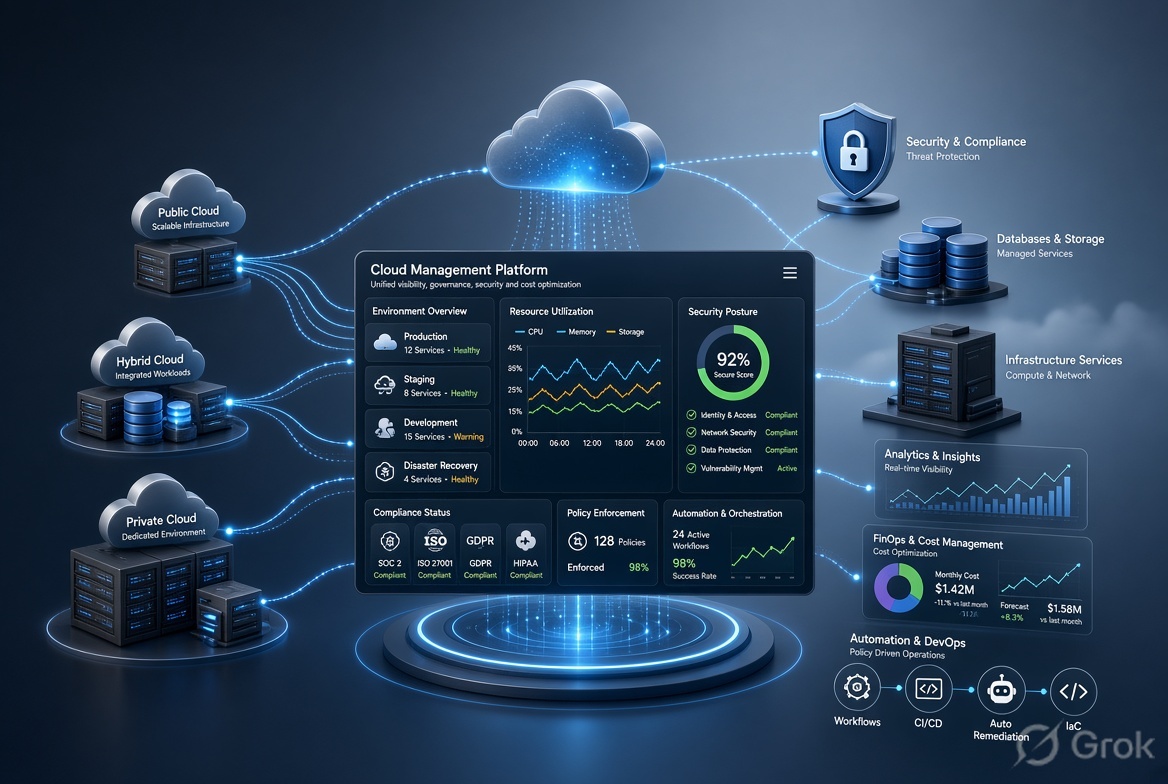
Cloud management platforms bring together tools for monitoring infrastructure, controlling costs, improving security, automating operations and managing resources across complex environments. For businesses, the goal is not simply to reduce cloud spending. It is to ensure that every dollar spent on cloud infrastructure contributes measurable business value.
Cloud Management Platform Snapshot
- Cloud management platforms provide centralized visibility across cloud resources.
- Businesses can use them to monitor infrastructure, costs, performance and security.
- FinOps is becoming an important part of modern cloud management.
- Multi-cloud and hybrid-cloud environments increase the need for centralized management.
- Automation can help organizations reduce waste and improve operational efficiency.
- Cloud management is increasingly becoming a business strategy rather than simply an IT function.
What Is a Cloud Management Platform?
A cloud management platform is a collection of software tools designed to help organizations monitor, control and optimize their cloud environments.
Depending on the platform, capabilities can include:
- Cloud cost monitoring
- Resource management
- Performance monitoring
- Security and compliance
- Infrastructure automation
- Workload optimization
- Budgeting and forecasting
- Governance and policy enforcement
- Multi-cloud management
- Reporting and analytics
Traditional IT management was often based around physical infrastructure located inside company facilities. Cloud computing changed that model by allowing resources to be created, expanded and removed dynamically.
That flexibility is powerful, but it also makes cloud environments more difficult to manage.
For example, a development team can create cloud resources within minutes. If those resources are no longer required but remain active, the organization may continue paying for them.
A cloud management platform can identify unused resources, monitor consumption and provide administrators with information needed to make better decisions.
Why Cloud Costs Can Become Difficult to Control
One of the biggest reasons businesses are investing in cloud management is cost visibility.
Cloud services generally operate using consumption-based pricing. Companies can pay for computing resources, storage, networking, databases and other services according to their usage.
This model can be more flexible than maintaining physical infrastructure, but it also introduces variable costs.
A rapidly growing application, for example, may suddenly consume significantly more computing resources. A company may also have development environments running continuously even when they are not being used.
Cloud spending can therefore become difficult to predict without appropriate monitoring.
The FinOps Foundation describes FinOps as an operational framework and cultural practice designed to maximize the business value of technology while creating financial accountability across engineering, finance and business teams.
This represents an important change in how businesses think about cloud costs.
Cloud optimization is no longer simply the responsibility of an IT administrator. Finance teams, engineers, business leaders and product teams increasingly need access to the same cost and usage information.
Microsoft’s FinOps guidance also emphasizes maximizing the business value generated from cloud technology while maintaining appropriate performance, reliability and security.
The Growing Importance of FinOps
FinOps has become closely connected with modern cloud management.
The FinOps Foundation describes FinOps as an operational framework and cultural practice designed to maximize the business value of technology while creating financial accountability across engineering, finance and business teams.
The FinOps Framework organizes the discipline around understanding usage and cost, quantifying business value, optimizing usage and rates, and managing the FinOps practice.
The framework also emphasizes collaboration between engineering, finance, leadership, procurement and product teams.
This matters because the cheapest cloud architecture is not necessarily the best architecture.
A business might save money by reducing computing resources, but if application performance falls and customers leave, the organization has not actually improved its business value.
Effective FinOps therefore attempts to balance several objectives:
- Cost
- Performance
- Reliability
- Security
- Business growth
- Customer experience
For cloud management platforms, this creates an opportunity to connect financial information with technical and operational data.
Multi-Cloud Makes Management More Complicated
Many enterprises no longer depend on a single cloud provider.
A company might use Amazon Web Services for some workloads, Microsoft Azure for enterprise applications and Google Cloud for specific data or artificial intelligence workloads.
Businesses may also operate private cloud infrastructure alongside public cloud services.
This creates a multi-cloud or hybrid-cloud environment.
The advantage is flexibility. Organizations can choose the platform that best fits a particular workload.
The disadvantage is complexity.
Each cloud provider has its own pricing structures, management interfaces, security controls and monitoring tools.
A centralized cloud management strategy can help organizations create a more consistent operational view across these environments.
Instead of forcing administrators to monitor every environment separately, management platforms can aggregate information into centralized dashboards and reporting systems.
Cloud Management Is Also About Security
Cost optimization is only one part of cloud management.
Security has become equally important as companies move sensitive applications and data into cloud environments.
Poorly configured cloud resources can expose data, applications or infrastructure to unnecessary risk.
A cloud management platform can support security through capabilities such as policy enforcement, identity controls, configuration monitoring, compliance reporting and automated alerts.
Security teams can also use centralized visibility to identify unusual activity or configuration changes.
This becomes particularly important as organizations adopt artificial intelligence and increasingly complex cloud workloads.
AI agents are another example of software becoming increasingly dependent on cloud infrastructure, APIs and intelligent automation.
As AI workloads expand, businesses will need to manage not only traditional cloud resources but also increasingly expensive GPU infrastructure, data pipelines and specialized computing environments.
Automation Can Reduce Cloud Management Work
Another major advantage of modern cloud management platforms is automation.
IT teams cannot manually monitor every resource in a large enterprise environment.
Automation can help identify unused resources, enforce policies, generate alerts and perform predefined optimization actions.
For example, an organization could establish policies that automatically shut down selected development resources outside working hours.
Other automated processes could identify storage that has not been accessed for a long period or alert teams when cloud spending exceeds a predefined threshold.
The objective is not to automate every decision.
Instead, automation should reduce repetitive administrative work so engineers can focus on higher-value tasks.
Cloud Management Platforms Are Becoming Strategic Tools
Cloud management was once primarily viewed as an infrastructure problem.
That perception is changing.
Cloud infrastructure now supports customer-facing applications, artificial intelligence, data analytics, SaaS products and critical enterprise systems.
As a result, cloud decisions can directly influence revenue, customer experience and business competitiveness.
The most effective organizations are therefore likely to treat cloud management as part of broader business planning.
A platform that connects infrastructure usage, financial data, operational performance and security information can give business leaders a much clearer understanding of their technology investments.
TechKip recently examined how the rapid expansion of AI workloads is driving a new cloud computing race, with organizations investing heavily in infrastructure capable of supporting demanding AI applications.
What Businesses Should Look for in a Cloud Management Platform
Not every organization needs the same cloud management capabilities.
A small company operating a relatively simple cloud environment may only require cost monitoring, performance dashboards and basic security controls.
A large enterprise operating multiple cloud providers may require a much broader platform covering governance, automation, FinOps, compliance and infrastructure operations.
Several capabilities should therefore be considered when evaluating a cloud management solution.
1. Cost Visibility
The platform should make it easy to understand where cloud money is being spent.
Useful features can include:
- Cost dashboards
- Department-level allocation
- Budget monitoring
- Forecasting
- Usage reports
- Spending alerts
- Anomaly detection
AWS provides cloud financial management capabilities covering cost transparency, control, forecasting and optimization. Its guidance also includes dashboards, optimization, spend limits, chargeback and anomaly detection.
2. Performance Monitoring
Cloud resources need to deliver reliable performance.
A management platform should therefore provide information about application performance, infrastructure utilization, availability and potential bottlenecks.
This can help IT teams determine whether a workload has insufficient resources or is consuming more resources than necessary.
The objective is to avoid both extremes: under-provisioning that damages performance and over-provisioning that increases costs unnecessarily.
3. Security and Governance
Enterprise cloud environments need clear policies.
Management platforms can help organizations establish rules governing who can create resources, where workloads can operate and which configurations are permitted.
Governance is particularly important for highly regulated organizations that need to demonstrate compliance with internal policies or external requirements.
4. Automation
Automation can significantly reduce operational workload.
A platform should ideally support automated workflows for routine tasks such as resource provisioning, policy enforcement, alerts and optimization.
However, organizations should introduce automation carefully.
Automatically deleting or modifying resources without appropriate safeguards could create operational problems.
A good cloud management strategy combines automation with approval mechanisms and clear governance.
5. Multi-Cloud Visibility
For organizations using several cloud providers, centralized visibility can be especially valuable.
A management platform should make it easier to compare resource usage, spending and performance across environments.
This can also help organizations identify workloads that may be better suited to a different infrastructure environment.
Cloud Management and AI Are Becoming Closely Connected
Artificial intelligence is increasing the complexity of cloud infrastructure.
As organizations increasingly use AI-powered applications, the relationship between cloud infrastructure and on-device computing is also changing.
AI applications can require large amounts of computing power, high-performance accelerators, extensive storage and sophisticated data pipelines.
This creates a new challenge for businesses: how to manage AI infrastructure efficiently.
Traditional cloud cost-management approaches may not always provide enough insight into rapidly changing AI workloads.
Organizations may need to monitor metrics such as GPU utilization, inference costs, model usage and data-processing expenses.
This is likely to make AI cost management an increasingly important part of FinOps.
The FinOps Foundation’s current framework already recognizes AI as one of the technology spending areas that can be managed alongside public cloud, SaaS, data centres and other technology categories.
As AI adoption grows, cloud management platforms are likely to evolve from monitoring infrastructure to helping businesses understand the economic value of AI workloads.
The growth of AI infrastructure is also accelerating interest in new forms of intelligent automation, including AI-powered personal robotics.
The Shift From Cloud Cost Cutting to Cloud Value Optimization
One of the biggest changes in cloud management is the move away from simply asking:
“How can we reduce our cloud bill?”
A more useful question is:
“How can we generate greater business value from our cloud investment?”
This distinction matters.
A company might reduce its cloud bill by moving to cheaper infrastructure, but if application performance suffers, the saving could ultimately cost the business more.
The development of AI world models could further increase demand for cloud computing, particularly for training and operating sophisticated robotic systems.
Similarly, an AI workload may be expensive but could generate significant revenue or productivity improvements.
FinOps therefore encourages organizations to consider business value alongside cost.
The FinOps Foundation’s 2025 framework expanded the concept toward “Cloud+” management, reflecting the growing need to manage technology spending across areas such as public cloud, SaaS, data centres, licensing and AI.
This broader approach could become increasingly important as enterprise technology environments become more fragmented.
Industry Outlook
The cloud management market is likely to become increasingly sophisticated as businesses adopt multi-cloud infrastructure, AI applications and SaaS at the same time.
The next generation of platforms is likely to combine several functions that were traditionally handled separately.
Cost management, infrastructure monitoring, security, governance, automation and business analytics could increasingly operate through interconnected platforms.
AI itself may also become part of cloud management.
Intelligent systems could eventually identify unusual spending patterns, recommend infrastructure changes, predict capacity requirements and explain why costs are increasing.
However, organizations will still need human oversight.
Cloud infrastructure supports critical business applications, so cost optimization decisions cannot always be delegated to automated systems.
The most valuable platforms will likely be those that combine automation with transparency and human control.
TechKip Perspective
Cloud computing has already changed the economics of enterprise technology.
Businesses no longer need to purchase enormous amounts of infrastructure before launching a digital service. They can scale resources according to demand and experiment with new technologies much faster.
But flexibility comes with complexity.
As organizations operate more cloud services, applications, SaaS products and AI workloads, simply having access to infrastructure is no longer enough.
Businesses need to understand what they are using, what it costs, how securely it is operating and whether it is producing meaningful business value.
That is why cloud management platforms are becoming increasingly important.
The future of cloud management is unlikely to be about finding the absolute cheapest infrastructure.
Instead, it will be about achieving the right balance between cost, performance, reliability, security and business outcomes.
For enterprises, that could make cloud management one of the most important components of modern IT strategy.
Frequently Asked Questions
What is a cloud management platform?
A cloud management platform is software that helps organizations monitor, control and optimize cloud infrastructure, spending, performance, security and governance.
Why do businesses need cloud management platforms?
Businesses use them to improve visibility, control cloud spending, monitor infrastructure, automate repetitive tasks and strengthen governance across increasingly complex environments.
What is FinOps?
FinOps is an operational framework and cultural practice that brings engineering, finance and business teams together to maximize the value of technology spending.
Does cloud management only focus on reducing costs?
No. Modern cloud management also focuses on performance, reliability, security, governance and business value. Reducing costs at the expense of performance or reliability may not produce a better business outcome.
Is cloud management important for AI workloads?
Yes. AI applications can require significant computing, storage and data-processing resources. Effective management can help organizations understand AI infrastructure costs and optimize resource utilization.
Is cloud management useful for small businesses?
It can be. Smaller organizations may not require an extensive enterprise platform, but basic cost monitoring, security, automation and resource-management capabilities can still help prevent unnecessary spending.
Final Thoughts
Cloud infrastructure is becoming a fundamental part of modern business operations, but managing it effectively is becoming increasingly difficult.
Cloud management platforms provide organizations with a way to bring together cost visibility, infrastructure monitoring, security, governance and automation.
The rise of FinOps is also changing the conversation around cloud spending. Instead of treating cloud costs as an isolated IT expense, businesses are increasingly looking at technology spending in terms of business value.
As AI, multi-cloud environments and SaaS adoption continue to expand, that approach will become even more important.
For businesses planning their next stage of digital transformation, the question may no longer be whether they need cloud management.
It may be how intelligently they can manage the cloud infrastructure they already have.