
Last Updated on April 20, 2026 by Michael Motha
2026 is emerging as a major turning point in the evolution of mobile technology. With AI agents becoming more capable of handling complex tasks across multiple apps, the traditional app-centric experience is starting to shift. However, this does not mean mobile apps are disappearing — instead, they are evolving into a deeper, more integrated digital layer powered by AI.
As the rise of intelligent systems accelerates, broader developments in AI technology trends are shaping how users interact with digital ecosystems beyond traditional apps.
The Rise of AI “Super Agents”
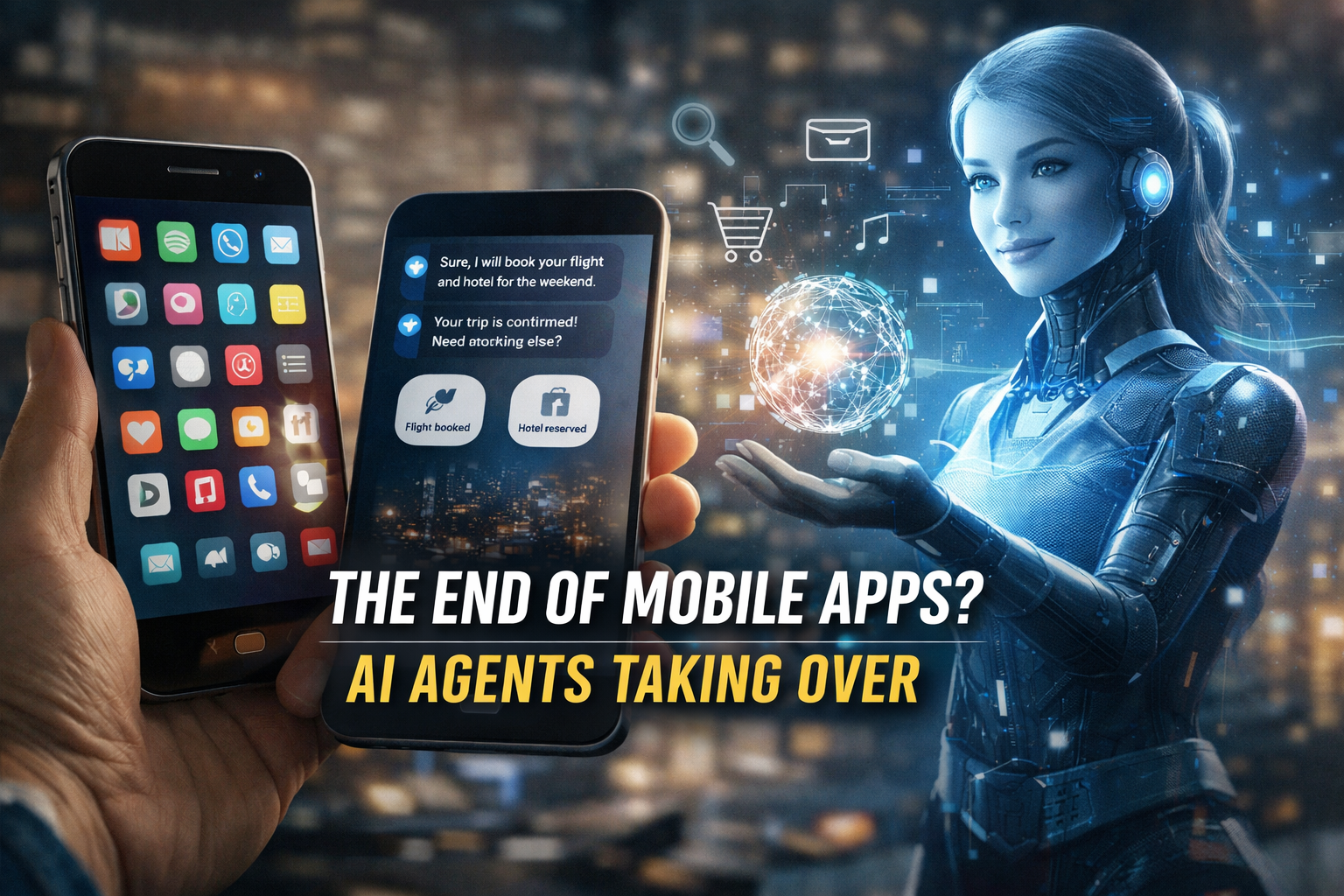
Instead of opening multiple apps for tasks like booking a flight, ordering food, or managing emails, users are now starting to rely on AI agents that can perform all these actions in one conversation.
These systems are powered by advanced large language models and real-time automation tools.
For example:
- A user says: “Book a weekend trip to Goa under ₹20,000.”
- The AI agent handles flights, hotels, comparisons, and payments automatically.
This eliminates the need for switching between apps entirely.
Will AI Agents Replace Mobile Apps Completely?
Despite rapid advancements, AI agents are unlikely to fully replace mobile apps by 2026. Instead, they will act as an intelligent execution layer that connects and automates existing apps.
Mobile apps will still provide infrastructure, interfaces, and data storage, while AI agents will handle decision-making and task execution.
Apple and Google Are Quietly Transforming Mobile OS
Both Apple and Google are restructuring their ecosystems to support AI-first experiences.
Apple is integrating deeper intelligence layers into iOS, where Siri evolves into a full system-level assistant capable of controlling apps, summarizing data, and executing tasks across services.
Google, meanwhile, is pushing Gemini-powered experiences that blur the line between search, apps, and automation.
Instead of opening YouTube, Gmail, or Maps separately, users may soon interact with a unified AI layer.
Google’s ongoing advancements in AI are central to this shift, with continuous improvements highlighted in its official Google AI updates.
The Decline of Traditional App Stores
App stores have been central to mobile ecosystems for years, but their importance is fading.
Why?
Because AI agents eliminate the need to install multiple apps for different tasks.
Instead of downloading:
- A travel app
- A food delivery app
- A booking app
Users simply ask one AI assistant.
This shift could significantly disrupt Apple’s App Store and Google Play Store revenue models in the coming years.
This shift also raises major questions about the future of mobile applications, especially as app-based ecosystems face disruption from AI-driven automation.
How AI Agents Are Changing User Behavior
User behavior is shifting from interaction-based usage to intent-based execution.
Old model:
Open app → navigate → search → execute task
New model:
Ask AI → task completed instantly
This transformation reduces screen time but increases dependency on AI systems for decision-making.
Experts call this shift the rise of “invisible computing.”
Cybersecurity Concerns Are Rising
While AI agents offer convenience, they also introduce serious risks.
If an AI system has access to emails, payments, and personal data, it becomes a high-value target for attackers.
Cybersecurity experts warn that:
- Prompt injection attacks may manipulate AI decisions
- Data leaks could become more severe
- Identity spoofing risks increase significantly
However, experts warn that increasing dependency on AI systems introduces serious AI security threats that could reshape digital risk landscapes.
Startups Racing to Build the “AI OS”
Startups are now racing to build full AI operating systems.
Companies are experimenting with:
- Voice-first smartphones
- Agent-only interfaces
- App-less ecosystems
Some even predict that smartphones in the future may not display icons at all—just conversational interfaces.
External Industry Shift
Big tech companies are aligning toward a unified goal: reduce friction between intent and action.
- OpenAI is expanding agent capabilities in ChatGPT ecosystems
- Google is embedding Gemini across Android and Workspace
- Apple is integrating on-device intelligence for privacy-first AI
This transformation is also driving a wave of AI startup innovations, as companies race to build app-less digital ecosystems.
Similarly, OpenAI’s rapid evolution of agent-based systems is detailed in its latest OpenAI platform updates, which focus on real-world automation capabilities.
What This Means for Users in 2026
For users, the biggest change is simplicity.
Instead of learning apps, users will learn how to communicate intent effectively.
However, this also raises concerns:
- Loss of control over processes
- Over-reliance on AI systems
- Reduced transparency in decision-making
Despite these concerns, adoption is accelerating rapidly.
For a foundational understanding, readers can explore how AI assistants replacing mobile apps first began reshaping user behavior in earlier stages of this transition.
Conclusion: The End of Apps as We Know Them?
The shift toward AI agents represents one of the biggest transformations in mobile computing history.
We are moving from:
“App-based interaction”
“AI-driven execution”
While apps will not disappear overnight, their role is rapidly shrinking as AI systems become the new digital interface layer.
FAQs
A: AI agents will not fully replace mobile apps but will significantly change how users interact with them.
A: Mobile apps are tools with fixed interfaces, while AI agents perform tasks autonomously across multiple systems.
A: Companies like OpenAI, Google, and Microsoft are actively developing AI-driven assistant systems.
A: No, but their role is shifting from user interface tools to backend systems supporting AI agents.