


Last Updated on May 20, 2026 by Michael Motha
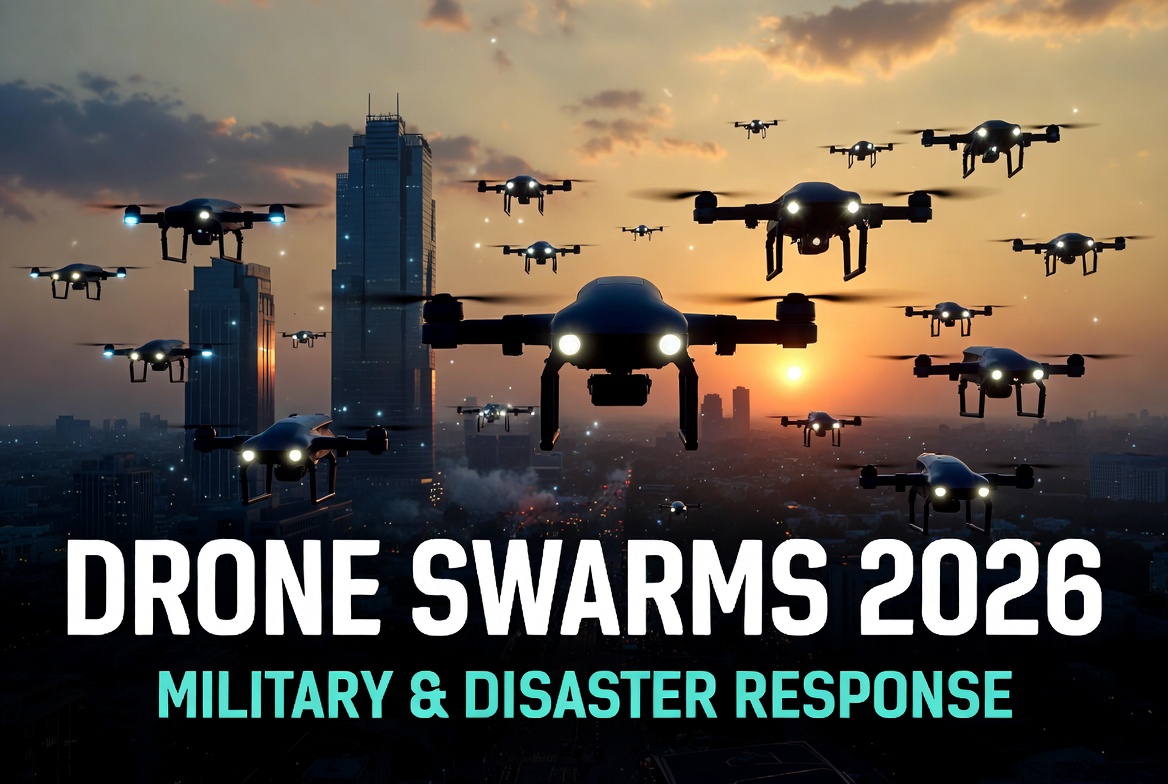
Drone swarms have moved from experimental demonstrations to real-world operational deployment in 2026. In May alone, multiple militaries and humanitarian organizations have successfully tested and used coordinated swarms of dozens to hundreds of autonomous drones for complex missions. This technology represents a fundamental shift in how aerial operations are conducted, offering unprecedented scalability, redundancy, and intelligence.
The rapid progress in swarm intelligence, AI coordination, and low-cost drone hardware has turned what was once science fiction into practical capability. For the latest updates on how emerging technologies like AI and robotics are reshaping industries, revisit the Techkip homepage.
Military Adoption of Drone Swarms in 2026
Several countries have made significant strides in swarm technology this year. The U.S. military, through DARPA and the Navy, has conducted large-scale swarm exercises involving over 200 drones working together to overwhelm enemy defenses. China and Israel have also demonstrated advanced swarm capabilities in recent field tests.
These swarms use collective intelligence to share data, adapt to threats in real time, and complete missions even if individual drones are lost. This “quantity over quality” approach is changing modern warfare tactics dramatically.
Disaster Relief and Humanitarian Applications
One of the most promising civilian uses of drone swarms in May 2026 has been in disaster response. After major flooding in Southeast Asia and earthquakes in South America, swarms of small drones were deployed to map affected areas, deliver emergency supplies, and locate survivors much faster than traditional methods.
Organizations like the Red Cross and UN humanitarian agencies are increasingly partnering with drone companies to integrate swarm technology into their emergency response protocols. The ability to cover large areas quickly and provide real-time data is proving invaluable in time-critical situations.
Technological Breakthroughs Enabling Swarms
The key enablers in 2026 are advanced AI algorithms for decentralized coordination, improved mesh networking between drones, and low-cost, lightweight hardware. Drones can now operate with minimal central control, making the swarm more resilient to jamming or loss of communication with base stations.
As noted in recent Drone Industry Insights report, swarm technology has seen the fastest development curve among all drone categories this year.
Commercial and Industrial Uses Emerging
Beyond military and humanitarian applications, commercial drone swarms are being tested for large-scale infrastructure inspection, agriculture monitoring, and environmental surveying. Companies are exploring swarms for warehouse inventory management and rapid delivery in dense urban environments.
The integration of edge AI in modern drone swarms highlights why our Artificial Intelligence category continues to deliver critical forward-looking analysis.
Challenges and Ethical Considerations
Despite the progress, challenges remain. Swarm coordination in complex environments, cybersecurity risks, collision avoidance, and regulatory hurdles are still being addressed. There are also growing ethical and legal questions around the use of lethal autonomous drone swarms in warfare.
Readers interested in broader technology developments can explore the full Technology category or Drones category on Techkip.Despite rapid progress, several challenges persist. Airspace congestion in dense urban areas, weather dependency, public privacy concerns, and the need for further safety improvements remain important issues. Battery technology, while improved, still limits payload capacity for larger packages.
The Road Ahead for Drone Swarms
As May 2026 continues, experts expect further breakthroughs in swarm size, intelligence, and reliability. The technology is poised to become a standard tool in multiple sectors, fundamentally changing how aerial operations are planned and executed.
FAQ – Drone Swarms 2026
A: A group of autonomous drones that communicate and coordinate with each other to complete missions collectively.
A: Yes. Several militaries and humanitarian organizations have deployed them in 2026.
A: Scalability, redundancy, lower cost per unit, and the ability to cover large areas quickly.
A: Stay updated with daily insights by following Techkip.
The rise of drone swarms in 2026 is more than just a technological advancement — it is a paradigm shift that will influence defense strategies, emergency response, and commercial operations for decades to come.