


Last Updated on July 27, 2026 by admin
For decades, improvements in battery technology have powered nearly every major advancement in consumer electronics. Smartphones have become faster, electric vehicles have become more practical, and portable devices have become increasingly capable—all because batteries have gradually improved.
Yet many of today’s batteries still face familiar limitations, including charging speed, energy density, and long-term durability.
Scientists are now exploring an entirely different concept known as quantum batteries. While the technology remains in the research stage, it has attracted growing attention because it could fundamentally change how energy is stored and transferred in future electronic devices.
Rather than representing an incremental improvement over today’s lithium-ion batteries, quantum batteries could introduce entirely new principles based on quantum physics that may dramatically improve charging efficiency under specific conditions.
Although commercial products remain years away, research in this field highlights how physics may influence the next generation of energy storage technologies.
🔬 Science Snapshot: Key Takeaways
- Quantum batteries are an emerging research field based on quantum physics.
- Scientists are investigating whether quantum effects can improve charging efficiency.
- The technology remains experimental and is not yet commercially available.
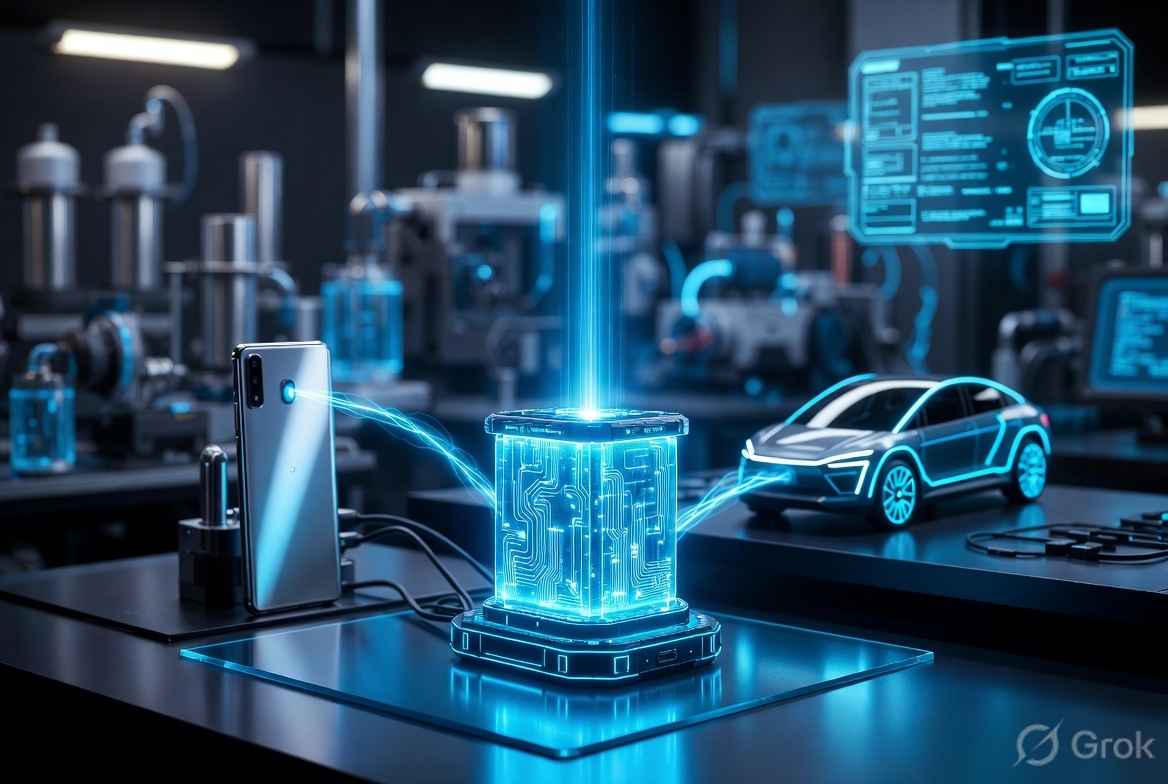
- Future applications could include smartphones, electric vehicles, robotics, and renewable energy systems.
Why Traditional Batteries Face Growing Challenges
Modern lithium-ion batteries have transformed technology over the past three decades, but they also face physical limitations.
Consumers increasingly expect smartphones that last longer, electric vehicles that charge faster, and wearable devices that operate for extended periods without frequent recharging.
As explored in TechKip’s feature How On-Device AI Is Redefining Smartphones Without Sending Your Data to the Cloud, increasingly powerful AI features are placing greater demands on smartphone batteries, making next-generation energy technologies an important area of future research.
At the same time, artificial intelligence, advanced graphics processing, and high-performance mobile computing continue increasing energy demands across modern electronics.
These challenges have encouraged researchers to explore entirely new approaches to energy storage rather than relying solely on incremental improvements to existing battery chemistry.
What Makes Quantum Batteries Different?
Unlike conventional batteries that store energy through chemical reactions, quantum batteries are based on principles from quantum mechanics.
Researchers are studying how quantum phenomena—including coherence and collective quantum behavior—might enable more efficient charging under carefully controlled conditions.
IBM Quantum continues advancing quantum computing research that helps scientists better understand quantum systems and their potential technological applications.
This does not mean future batteries will contain mysterious “quantum power.” Instead, scientists are investigating whether quantum effects can improve the way energy is absorbed, stored, and transferred at microscopic scales.
While many engineering challenges remain unresolved, early laboratory research suggests the concept is scientifically promising.
Why Researchers Are Paying Attention
Quantum batteries have attracted interest because they could potentially address several long-term technological challenges.
If future research successfully translates laboratory concepts into practical devices, quantum batteries might contribute to:
- Faster charging times
- Improved energy efficiency
- Better performance for compact electronics
- Reduced charging losses
- Enhanced support for future AI-powered devices
- More efficient renewable energy storage
Researchers caution, however, that these possibilities remain the subject of ongoing scientific investigation rather than commercial reality.
The U.S. Department of Energy supports research into advanced energy storage technologies, including next-generation battery science aimed at improving future energy systems.
Potential Applications Beyond Smartphones
Although smartphones frequently attract public attention, quantum batteries could eventually influence many industries.
Possible future applications include:
- Consumer electronics
- Electric vehicles
- Medical devices
- Space exploration
- Robotics
- Renewable energy storage
- Industrial automation
- Internet of Things (IoT) devices
Longer-lasting energy systems could also support intelligent robotics. TechKip recently explored this trend in AI Personal Robots Could Be the Next Big Technology Revolution, highlighting how advances in battery technology may eventually improve the practicality of future household robots.
Each application would require significant engineering breakthroughs before becoming commercially viable, but the underlying research continues expanding.
Quantum Batteries vs Lithium-Ion Batteries
| Lithium-Ion Batteries | Quantum Batteries (Research Stage) |
|---|---|
| Commercially available | Experimental research |
| Chemical energy storage | Quantum-mechanical energy concepts |
| Proven manufacturing | Laboratory investigations |
| Gradual improvements | Potential new charging mechanisms |
| Widely used today | Future possibility |
The Engineering Challenges Ahead
Quantum batteries have generated excitement within the scientific community, but significant engineering obstacles remain before they can become practical consumer products.
One of the biggest challenges is maintaining quantum states for meaningful periods. Quantum systems are extremely sensitive to their environment, and even small disturbances can reduce the effects researchers are attempting to harness.
Scientists must also determine how laboratory demonstrations can be scaled into reliable, affordable batteries capable of powering millions of devices under everyday conditions.
Manufacturing processes, safety standards, long-term durability, and commercial production methods all require substantial breakthroughs before quantum batteries could compete with today’s lithium-ion technology.
For these reasons, most researchers view quantum batteries as a promising long-term research direction rather than an immediate replacement for existing battery technologies.
Could Quantum Batteries Transform Electric Vehicles?
Electric vehicles continue improving through better battery chemistry, faster charging networks, and more efficient power management.
If quantum battery research eventually leads to practical commercial systems, future electric vehicles could benefit from faster charging and improved energy efficiency. However, these possibilities remain theoretical and depend on overcoming significant scientific and engineering challenges.
For consumers, the greatest benefit would not simply be shorter charging times, but greater confidence in using electric vehicles for long-distance travel without lengthy charging stops.
Although today’s electric vehicle manufacturers continue relying on advanced lithium-ion technologies, research into next-generation batteries may influence future transportation in the decades ahead.
Renewable Energy Could Also Benefit
Renewable energy sources such as solar and wind produce electricity intermittently, making efficient energy storage increasingly important.
The MIT Energy Initiative supports research into advanced energy systems and emerging technologies that could improve future energy production, storage, and sustainability.
Future battery technologies—including concepts currently being explored through quantum battery research—could potentially help store renewable energy more efficiently if they prove practical at commercial scale.
Improved energy storage would support greater grid stability, reduce energy waste, and increase the use of renewable power across homes, businesses, and industries.
While these possibilities remain speculative today, they illustrate why researchers continue investigating alternative battery technologies beyond conventional chemistry.
Why Scientific Research Matters
Many groundbreaking technologies began as scientific ideas long before becoming commercial products.
Semiconductors, lasers, GPS, and lithium-ion batteries all required years—sometimes decades—of research before reaching consumers.
Quantum battery research represents a similar journey.
Leading scientific journals such as Nature regularly publish peer-reviewed research covering advances in quantum science, energy storage, and emerging battery technologies.
Whether or not today’s concepts become tomorrow’s products, the research itself expands scientific understanding and may lead to unexpected discoveries that improve future energy storage.
Investment in fundamental science often creates innovations that extend far beyond their original objectives.
TechKip Perspective
Battery technology rarely receives the same public attention as artificial intelligence or smartphones, yet it quietly determines how far nearly every modern technology can advance.
As TechKip explained in Why AI Is Triggering the Biggest Cloud Computing Race in History, expanding AI infrastructure is also increasing demand for efficient energy systems, making advances in battery technology increasingly important across the broader technology ecosystem.
Smarter AI systems, more capable robots, longer-lasting smartphones, and wider adoption of electric vehicles all depend on continued progress in energy storage.
Quantum batteries should therefore be viewed not as guaranteed future products, but as an example of how scientific research continues searching for entirely new ways to solve long-standing technological challenges.
Whether the final solution comes from quantum batteries or another emerging technology, the pursuit of better energy storage will remain one of the most important scientific goals of the coming decades.
Final Thoughts
Quantum batteries remain an exciting area of scientific exploration rather than a commercial reality.
Researchers continue investigating whether quantum mechanics can unlock new methods of storing and transferring energy more efficiently than conventional technologies.
Although widespread consumer adoption may still be years away, the research demonstrates how advances in physics could eventually influence smartphones, electric vehicles, robotics, renewable energy systems, and countless other technologies.
For technology enthusiasts, the story of quantum batteries serves as a reminder that today’s scientific experiments often become tomorrow’s everyday innovations.
Frequently Asked Questions
A quantum battery is a theoretical and experimental energy storage concept that uses principles of quantum mechanics rather than conventional chemical reactions to investigate new ways of storing and transferring energy.
No. Quantum batteries remain in the research stage and are not commercially available for smartphones, electric vehicles, or consumer electronics.
It is too early to know. Researchers are still investigating whether quantum battery concepts can be engineered into practical, reliable, and affordable commercial products.
If successfully developed, potential applications could include consumer electronics, electric vehicles, robotics, renewable energy storage, medical technology, aerospace, and industrial automation.