


Last Updated on June 6, 2026 by Michael Motha
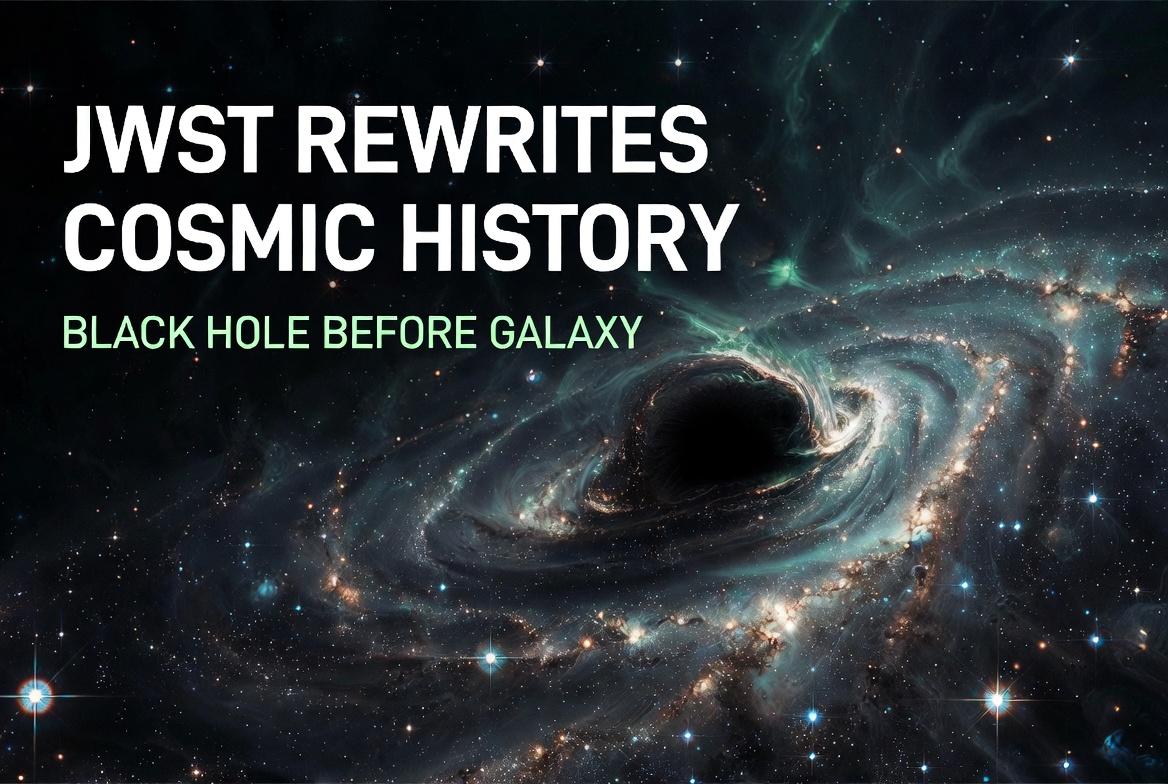
NASA’s James Webb Space Telescope (JWST) has once again delivered a discovery that is forcing scientists to rethink the fundamental timeline of the early universe. In late May 2026, astronomers announced the detection of a fully formed supermassive black hole that appears to have existed before its host galaxy had time to fully develop.
This unexpected finding challenges decades-old theories about how galaxies and black holes formed in the first few hundred million years after the Big Bang. For readers following previous JWST breakthroughs on this site, see our earlier article on JWST Exoplanet Atmosphere Discovery.
The Discovery in Detail
The black hole, located in a distant galaxy roughly 700 million years after the Big Bang, has a mass of several million suns and shows strong signs of active accretion. What shocked researchers is that the surrounding galaxy is still in an underdeveloped state — with far fewer stars and less structured formation than expected.
This “black hole first” scenario contradicts the standard model in which galaxies form first and black holes grow gradually inside them over time. For the latest updates on how space telescopes are reshaping our understanding of the cosmos, revisit the Techkip homepage.
Why This Finding Is So Significant
For decades, cosmologists assumed that supermassive black holes grew slowly by consuming gas and merging with other black holes inside maturing galaxies. The new JWST data suggests that in the early universe, massive black holes could form rapidly and directly from the collapse of enormous gas clouds — a process that was previously considered theoretically difficult or impossible at such an early cosmic epoch.
Technical Achievement of JWST
The discovery was made possible by JWST’s powerful Mid-Infrared Instrument (MIRI) and Near-Infrared Spectrograph (NIRSpec). These instruments allowed astronomers to peer through cosmic dust and analyze the light from this distant system in unprecedented detail. The observations revealed strong accretion signatures and high luminosity from the black hole while the host galaxy showed relatively low star formation activity.
As noted in the latest NASA JWST Science Update, this observation demonstrates the telescope’s unique capability to study the early universe in ways never before possible.
Implications for Galaxy Formation Theories
This discovery adds to a growing list of “impossible early universe” objects found by JWST, including overly mature galaxies and unexpectedly bright quasars. It indicates that the early universe may have been far more efficient at forming massive structures than current models predict.
Comparison with Previous JWST Discoveries
This new result builds upon earlier JWST observations of “little red dots” and other anomalous high-redshift black holes. Together, these findings are forcing a major rethink of cosmic evolution timelines and may require significant revisions to existing cosmological models.
Expert Reactions
Leading astronomers have described the discovery as “transformative” and “game-changing.” Many are calling for urgent follow-up observations and new theoretical models to explain how such massive black holes could form so quickly after the Big Bang.
Challenges and Open Questions
While the data is compelling, scientists emphasize caution. Confirming the exact timeline and mechanisms will require more observations. Key questions remain about the exact mass of the black hole, the star formation history of the galaxy, and whether similar objects are common in the early universe.
The Road Ahead for JWST
As May 2026 ends, follow-up observations of this system are already scheduled. Future missions and deeper JWST surveys will help determine how common these “black hole first” scenarios were in the early universe.
Readers interested in broader technology developments can explore the full Science category on Techkip.
The Bigger Picture
This discovery highlights JWST’s continuing role as one of the most transformative scientific instruments of our time. By revealing structures and processes from the early universe that were previously hidden, it is fundamentally changing our understanding of cosmic history.
FAQ – JWST Black Hole Discovery 2026
A: A supermassive black hole that appears to have formed before its host galaxy had fully developed.
A: It suggests black holes could form rapidly and independently rather than growing slowly inside galaxies.
A: No — JWST has repeatedly found mature structures much earlier than predicted.
A: Stay updated with daily insights by following Techkip.
The May 2026 JWST discovery of a black hole that formed before its galaxy is a stunning example of how our understanding of the early universe continues to evolve. It may prove to be one of the most important scientific findings of the decade.