


Last Updated on September 14, 2025 by admin
A Fiery Moon Adrift in a Frozen Neighborhood
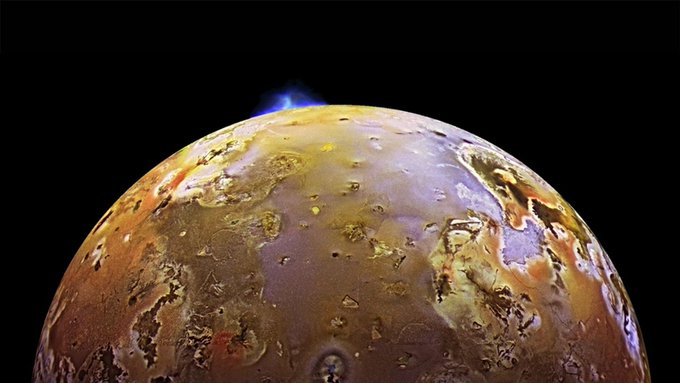
In the vast, cold outskirts of the solar system where frozen landscapes dominate and stillness is the norm, one moon breaks the silence with relentless energy. This moon is Io, one of Jupiter’s largest companions, and unlike its icy siblings, it exists in a perpetual state of eruption and renewal. From its colorful, sulfur-stained plains to its sky-piercing volcanic plumes, Io is a body shaped by violence, driven by internal and external forces that never allow it to rest. Though it resides in one of the coldest regions of the solar system, Io itself is the hottest world in terms of geological activity. Its surface roils with rivers of molten rock, towering lava fountains, and ash-covered plateaus that speak of eruptions both ancient and fresh.
What makes Io truly extraordinary is not only its capacity for volcanic activity, but the rate at which that activity occurs. The surface is constantly shifting, as if the moon itself refuses to settle into any permanent shape. Its features are temporary, ever-changing, sculpted not over millions of years, but within weeks or months. To stand on the surface of Io would be to witness a landscape in motion—a canvas being painted by a hand that never stops moving. The moon’s restless nature is not accidental, but the direct result of cosmic forces acting with incredible precision.
The Power of Tidal Heating
The source of Io’s fury lies not within traditional planetary mechanics like radioactive decay or tectonic drift. Instead, the heart of its volcanic force is a result of gravitational interactions. Orbiting close to the immense mass of Jupiter, Io is caught in a gravitational tug-of-war with two of its neighboring moons, Europa and Ganymede. These neighboring moons maintain a rhythmic influence on Io’s orbit, ensuring it never travels in a perfect circle. Instead, its path is slightly stretched, causing the moon to swing closer to and farther from Jupiter in regular intervals.
This elliptical orbit causes tremendous flexing of Io’s internal structure. As it moves closer to Jupiter, the moon is stretched by the gas giant’s intense gravitational pull. As it moves away, the stretching lessens. This continuous squeezing and releasing generates friction within Io’s interior. The friction, in turn, produces heat—not a gentle warmth, but a searing, rock-melting energy that transforms Io into a literal pressure cooker.
This internal friction keeps the moon’s interior in a constant state of molten turmoil. Reservoirs of magma bubble beneath the crust, waiting for release. When pressure builds too high, the surface gives way, and eruptions follow. These eruptions are not rare or occasional; they are continuous and widespread. Unlike the relatively limited volcanic zones on Earth, Io’s entire surface is a potential eruption site. The energy generated by tidal heating is sufficient to drive hundreds of active volcanoes, many of which erupt on a regular basis.
A Surface in Motion
The surface of Io is unlike anything found elsewhere in the solar system. Instead of stable mountain ranges or craters preserved over eons, Io presents a chaotic, freshly laid landscape. Lava flows stretch for immense distances across plains of sulfur and silicate rock. Some of these flows are so extensive they dwarf any volcanic features found on Earth. They twist through valleys, surround elevated plateaus, and branch out like roots across the moon’s tortured surface.
Volcanic pits, called paterae, dot the landscape like wounds. These depressions form as lava chambers collapse beneath the crust, only to refill and erupt again. The cycle is endless. New eruptions erase older features, and constant deposits of ash and sulfur coat the surface in ever-changing patterns. The result is a moon where the terrain never remains the same for long.
Coloration on Io is especially notable. The surface glows with vivid reds, deep blacks, bright whites, and intense yellows. These colors come primarily from sulfur and sulfur dioxide in various physical states. Ash clouds fall back to the surface and create pastel coatings, while solid sulfur crystallizes into brilliant hues. Some regions appear almost painted by hand, as if an artist had taken a brush to the terrain, blending minerals and temperatures to create surreal geological artwork.
Io lacks impact craters not because they never happen, but because they do not last. Any crater that forms from a collision is soon buried beneath lava or hidden beneath new volcanic layers. On other moons and planets, craters act like fossils—preserved stories from the past. On Io, those stories are overwritten almost as soon as they begin.
Volcanic Giants and Molten Lakes
Among Io’s most impressive features are its massive volcanic calderas. These structures, formed by collapsing lava chambers, can reach immense sizes and contain enormous quantities of molten rock. In some of these depressions lie active lava lakes that churn and bubble with energy. The surfaces of these lakes are constantly cracking, cooling, and reforming as molten material pushes upward. The crust solidifies briefly, only to break apart again in a never-ending cycle.
These lava lakes can remain active for long periods, serving as persistent hotspots on the surface. From time to time, they overflow their boundaries, sending sheets of lava across the landscape. These overflows can reshape surrounding areas dramatically, creating new geological features and destroying old ones in a matter of days.
Then there are the towering plumes—massive explosions of gas and molten material that shoot upward from the surface. Some plumes reach altitudes so high they extend far beyond Io’s thin atmosphere. These plumes often form umbrella-shaped clouds of gas and ash that eventually rain down, blanketing the surrounding terrain with freshly deposited material. Each eruption acts as both a destructive and creative force, removing old layers and replacing them with new ones.
The scale of these eruptions is staggering. Volcanic plumes can rise taller than entire planetary atmospheres. These immense blasts are not only powerful but regular. Io has been observed erupting on multiple occasions during spacecraft flybys, providing scientists with rare glimpses into real-time planetary change.
Toxic and Unforgiving Conditions
Despite its beauty and activity, Io is one of the most hostile places in the solar system. The atmosphere is barely present—a thin veil of sulfur dioxide gas that offers no protection from the vacuum of space or the radiation pouring in from Jupiter’s magnetosphere. There is no oxygen, no pressure suitable for life, and no water in any form. The temperature varies wildly from location to location, with some volcanic regions reaching searing heat, while shaded areas plummet to extreme cold.
Even more dangerous than the temperature is the radiation. Io orbits within Jupiter’s intense magnetic field, which traps charged particles and accelerates them around the planet at tremendous speeds. These particles bombard Io relentlessly, creating an environment with radiation levels that would be lethal to any unprotected human in moments. For spacecraft, this presents a significant challenge. Instruments must be specially shielded, and missions often keep flybys short to avoid damage.
Despite these dangers, Io’s environment plays an essential role in the Jovian system. Material ejected by its volcanoes escapes into space, becoming part of Jupiter’s magnetic environment. Io creates a ring of plasma, known as the Io plasma torus, that encircles the planet. This plasma interacts with Jupiter’s magnetic field and even contributes to its auroras—powerful light displays near the planet’s poles that dwarf Earth’s northern and southern lights.
A History of Exploration
Io’s journey from mysterious moon to geological marvel began centuries ago with the invention of the telescope. One of the first discoveries of celestial objects orbiting another planet, Io was initially seen as nothing more than a bright point near Jupiter. It wasn’t until space missions reached the outer planets that its secrets began to unfold. The first close images of Io revealed something no one expected—a volcanic plume, captured in a single photograph, rising from the surface. This image changed everything. It proved that volcanic activity was not exclusive to Earth and revealed the incredible diversity of geological processes in the solar system.
Subsequent missions returned with more detail, mapping the surface, measuring heat output, and capturing infrared images of active lava flows. These missions revealed a world more active than any scientist had imagined. Instruments measured constant changes in surface temperature, saw new plumes appear where none existed before, and watched old features vanish beneath fresh lava.
Even now, Io remains a target of interest. Modern spacecraft continue to make close passes, gathering new data and capturing updated imagery. Each mission adds to a growing library of knowledge that helps scientists understand not just Io, but the broader principles of planetary geology. The discoveries made on this moon have influenced how we study planets, moons, and exoplanets across the galaxy.
Scientific Significance Beyond One Moon
The study of Io extends far beyond its own surface. By observing this moon, scientists gain critical insights into how tidal heating operates, how extreme geological systems can exist, and how planetary bodies interact with one another in complex orbital systems. These insights are valuable not only within our solar system but also in the study of distant worlds.
Many exoplanets orbit their stars in close, tight paths, with gravitational interactions from neighboring planets or moons. These interactions may generate internal heat, just as they do on Io. The possibility of tidal heating creating volcanic activity—or even subsurface oceans—opens the door to a wider range of potentially habitable worlds, even in regions where sunlight alone is insufficient.
Io also serves as a case study in planetary renewal. Its surface is constantly renewed, offering a live example of how geological resurfacing can erase evidence of past events. This can help scientists better interpret planetary surfaces elsewhere, where missing craters or unusual features might indicate.