


Last Updated on April 19, 2026 by Michael Motha
Introduction: A Discovery That Changes the Martian Story
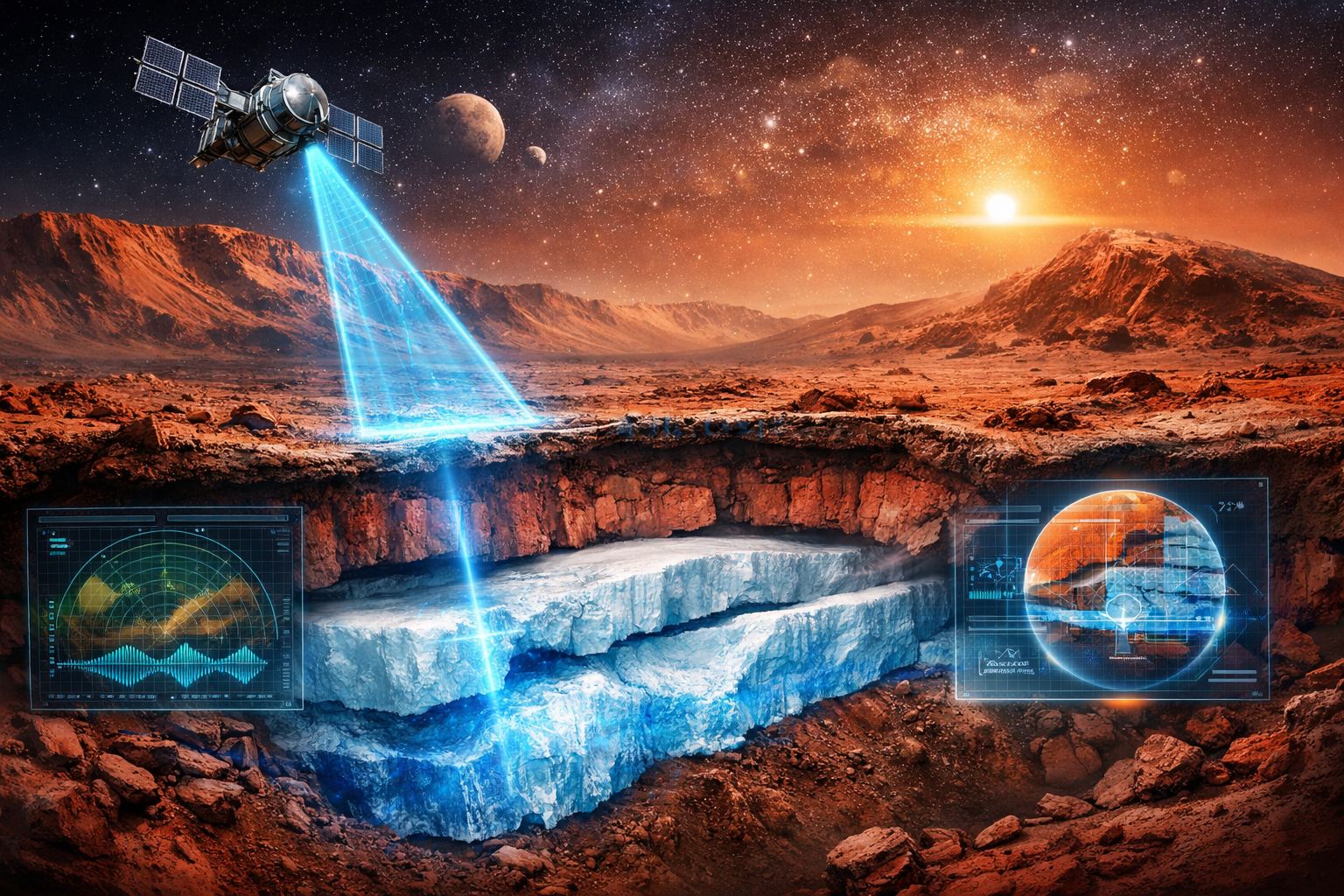
A new orbital radar study has revealed compelling evidence that Mars may contain far more subsurface water ice than previously estimated, potentially reshaping future human exploration strategies.
This discovery could significantly change how future Mars missions are planned, especially for long-term human habitation.
A new wave of scientific analysis has revealed compelling evidence that Mars may hold far more subsurface water ice than previously estimated. This discovery, based on high-resolution orbital radar and geological modeling, is reshaping how scientists think about future human missions and long-term colonization of the Red Planet.
For decades, Mars has been considered a cold and arid world. However, fresh data suggests that beneath its dusty surface lies a vast frozen water network that could support future exploration.
What Scientists Have Actually Found
Recent studies using radar instruments aboard orbiters have detected:
- Dense ice formations beneath mid-latitude regions
- Layered frozen deposits mixed with soil
- Possible ancient underground water flow channels
These findings suggest that Mars is not just a dry desert planet but may have once hosted a much more dynamic water system than previously believed.
NASA’s Mars Reconnaissance Orbiter (MRO), using the SHARAD radar instrument, continues to provide supporting data on subsurface ice deposits across Mars, strengthening current understanding of the planet’s hidden water structures through ongoing observations by NASA’s Mars exploration program.
Why This Discovery Matters for Space Exploration
If confirmed, this discovery changes everything about Mars missions.
Water is the most critical resource for:
- Drinking supply for astronauts
- Oxygen generation
- Rocket fuel production (hydrogen extraction)
- Long-term habitat sustainability
Instead of transporting massive water supplies from Earth, future missions could potentially extract resources directly from Mars.
This breakthrough is closely tied to advancements in AI systems used in space exploration and autonomous navigation.
How This Fits Into the Bigger Scientific Picture
This discovery is part of a larger global push in planetary science focused on:
- Ice detection on moons and planets
- Climate history of Mars
- Habitability of ancient planetary environments
NASA and other space agencies have been increasingly focused on identifying water-rich environments beyond Earth as part of long-term human exploration strategies.
Machine learning models are now widely used to process orbital radar and thermal imaging data in planetary science research.
How the Data Was Collected
The findings come from:
- Ground-penetrating radar systems on orbiters
- Thermal imaging of Martian surface layers
- Computational simulation of subsurface geology
These methods enable non-invasive subsurface analysis without physical drilling on Mars.
Findings are being compared against peer-reviewed planetary science studies published in leading journals such as Nature.
What This Means for Future Mars Missions
If underground water ice is widely accessible, it could:
- Reduce mission costs by billions of dollars
- Enable permanent Mars bases
- Support agriculture experiments on Mars
- Improve survival chances for astronauts
This pushes humanity one step closer to becoming a multi-planetary species.
Scientific Caution: Not Fully Confirmed Yet
Despite excitement, researchers emphasize that:
- Ice distribution is not uniform
- Extraction technology is still experimental
- Confirmation requires future lander missions
So while the data is promising, it is not yet ready for human exploitation.
The Bigger Future Impact
If future missions confirm large water reserves, Mars could shift from:
👉 a scientific exploration target
to
👉 a long-term human settlement candidate
This single discovery could redefine the next 50 years of space exploration. Related research on AI-driven space exploration is also shaping future planetary missions.
Readers can stay updated with the latest technology news on Techkip as discoveries emerge.