


Last Updated on April 22, 2026 by admin
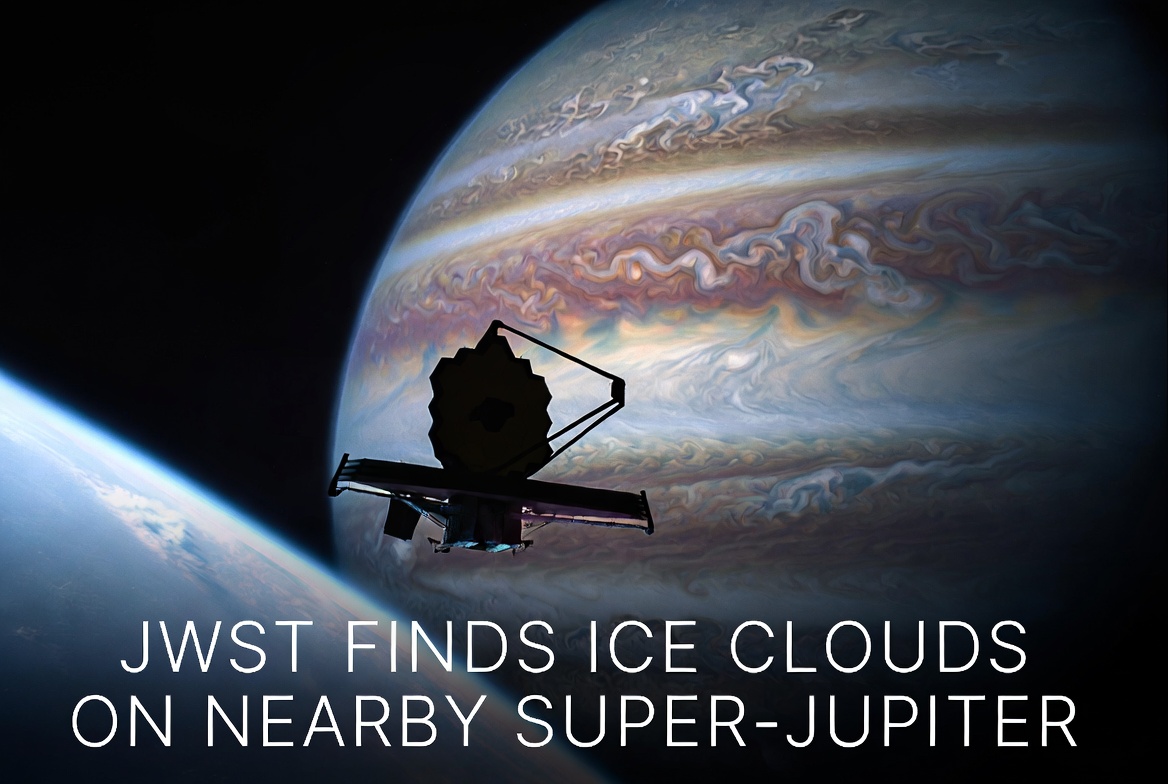
In a landmark scientific announcement on April 22, 2026, NASA’s James Webb Space Telescope (JWST) has achieved one of the most significant exoplanet discoveries of the current decade. Astronomers have confirmed the presence of thick, patchy water-ice clouds in the upper atmosphere of a cold super-Jupiter named Epsilon Indi Ab, located only 11.9 light-years from Earth. This discovery is generating widespread excitement in the astronomical community because it directly contradicts many long-standing theoretical predictions about the atmospheric composition and behavior of cold gas giants.
The planet Epsilon Indi Ab is particularly valuable to scientists because it is one of the closest known gas giants to our solar system. Its proximity combined with its relatively cool temperature has allowed JWST to use direct imaging techniques to study its atmosphere in unprecedented detail. The detection of water-ice clouds on this world provides crucial new insights into planetary formation processes, atmospheric dynamics, cloud physics, and the overall diversity of planets in our galaxy. Unlike most exoplanets that are either extremely hot or too distant for detailed study, Epsilon Indi Ab occupies a sweet spot that makes it an ideal laboratory for testing and refining atmospheric models.
ScienceDaily summary of the findings
The Target: Epsilon Indi Ab – Our Closest Super-Jupiter
Epsilon Indi Ab orbits a stable K-type orange dwarf star in the southern constellation Indus. With an estimated mass of 6 to 9 times that of Jupiter and equilibrium temperatures between 200 and 300 Kelvin, it belongs to a rare and scientifically valuable class of cold, massive gas giants. Its relatively short distance from Earth makes it an excellent target for detailed atmospheric characterization using advanced space telescopes.
While most known exoplanets are hot Jupiters orbiting very close to their host stars and studied primarily through transit spectroscopy, cold gas giants like Epsilon Indi Ab are far more difficult to observe because they emit and reflect much less light. However, JWST’s powerful infrared instruments have overcome these challenges, allowing scientists to study this distant world in remarkable detail. The discovery of water-ice clouds on Epsilon Indi Ab is especially noteworthy because it shows that even “simple” cold gas giants can have complex and dynamic atmospheres that previous models failed to predict accurately.
JWST’s Second Visit Delivers the Surprise
Early observations of Epsilon Indi Ab had detected tentative signs of ammonia in the atmosphere. Ammonia is an important chemical tracer used by astronomers to understand the composition and evolutionary history of cold giant planet atmospheres. However, during a second, more detailed observing campaign using JWST’s Mid-Infrared Instrument (MIRI), the data showed something unexpected: the ammonia absorption feature was significantly weaker than any cloud-free atmospheric models had predicted.
After extensive analysis that carefully ruled out instrumental artifacts, low metallicity, nitrogen depletion, and other chemical explanations, the international research team led by Dr. Elisabeth Matthews at the Max Planck Institute for Astronomy concluded that the most likely explanation is the presence of thick but patchy water-ice clouds high in the upper atmosphere, similar to Earth’s high-altitude cirrus clouds but on a planetary scale orders of magnitude larger.
Official press release from Max Planck Institute for Astronomy
These clouds are not uniform. They appear as broken, dynamic patches that create complex patterns of light scattering and absorption across different infrared wavelengths. This is the strongest evidence to date of water-ice cirrus-style clouds on a directly imaged cold exoplanet in this temperature range. The finding has already prompted several research groups to begin updating their atmospheric simulation codes to incorporate patchy water-ice cloud layers.
Why This Changes Everything for Exoplanet Models
This discovery forces a major revision in how scientists model cold gas giant atmospheres. For years, models assumed relatively clear upper layers or the presence of only ammonia-ice and sulfide-based clouds. The presence of prominent water-ice clouds requires completely new approaches to cloud microphysics, heat transport, vertical mixing, and spectral interpretation.
The implications extend far beyond this single planet. Better cloud models will improve our understanding of many other exoplanets, including those in habitable zones where clouds could play a decisive role in climate stability and potential habitability. The finding also highlights the critical importance of real observational data over pure theoretical modeling and underscores the recurring importance of water in its various forms throughout planetary atmospheres in the universe.
Techkip readers who followed our recent coverage of hidden subsurface water on Mars will recognize the broader pattern: water ice continues to appear in unexpected and scientifically important places across the cosmos.
Technical Details Behind the Discovery
The research team used JWST’s powerful Mid-Infrared Instrument (MIRI) in multiple photometric bands, including key wavelengths around 10.65 μm and 15.50 μm. By comparing the planet’s brightness across these filters, researchers observed clear deviations from cloud-free predictions. The planet appeared brighter than expected in some bands and fainter in others — a classic signature of high-altitude patchy water-ice clouds.
This second dedicated observing visit provided the high signal-to-noise data needed to reach strong scientific consensus. The peer-reviewed paper detailing these findings has been accepted for publication in The Astrophysical Journal Letters.
Implications for Future JWST Programs and Next-Gen Telescopes
This successful detection strongly validates JWST’s design and its unique capabilities for direct imaging of cold exoplanets. It paves the way for larger, systematic survey programs targeting similar objects around nearby stars. The new data will also help astronomers optimize observing strategies for the Extremely Large Telescopes (ELTs) currently under construction in Chile and for NASA’s upcoming Nancy Grace Roman Space Telescope.
Beyond gas giants, a deeper understanding of cloud formation and behavior is becoming increasingly vital for the study of smaller, rocky exoplanets in habitable zones. Clouds can regulate surface temperatures, shield or destroy potential biosignatures, and significantly affect how we interpret atmospheric spectra from these worlds. Accurate cloud modeling is therefore becoming a cornerstone of the search for life beyond our solar system.
Connection to Our Solar System and Broader Context
Epsilon Indi Ab serves as an excellent analog for studying the gas giants in our own solar system under different stellar and formation conditions. While Jupiter and Saturn are dominated by ammonia-ice clouds in their upper atmospheres, this distant super-Jupiter shows water ice playing a much more dominant role. This difference illustrates how stellar type, system age, and formation history can lead to dramatically different atmospheric compositions even among planets of similar mass.
The discovery adds to the growing body of evidence that water — whether in solid ice, liquid, or vapor form — is one of the most common and important substances involved in planet formation throughout the Milky Way galaxy. It also raises new questions about the role of water ice in the early stages of planetary system formation and how it influences the migration and evolution of giant planets.
What This Means for Everyday Tech and Public Interest
JWST itself stands as one of the greatest engineering achievements in human history. Its 18-segment gold-coated primary mirror, sophisticated cryogenic cooling systems, and ultra-sensitive infrared detectors are all operating flawlessly at the second Lagrange point, roughly 1.5 million kilometers from Earth. The success of this mission demonstrates the power of international collaboration and cutting-edge technology.
The same spirit of relentless technological innovation that made JWST possible also drives the rapid progress we see in consumer electronics, artificial intelligence, and other modern technologies. The latest gadget and AI breakthroughs covered on Techkip often share foundational technologies and engineering principles with space exploration missions. Space science and everyday technology continue to inspire and advance one another in remarkable ways.
Explore more connections between cutting-edge space research and modern consumer technology in our dedicated Technology category.
FAQ
What did JWST discover on Epsilon Indi Ab?
JWST discovered thick, patchy water-ice clouds high in the atmosphere of the cold super-Jupiter Epsilon Indi Ab.
How far is Epsilon Indi Ab from Earth?
The planet is approximately 11.9 light-years away, making it one of the closest known gas giants to our solar system.
Why are water-ice clouds scientifically important?
They require major updates to atmospheric models and greatly improve our ability to correctly interpret data from many other types of exoplanets.
Does this discovery help the search for alien life?
Indirectly yes. Better cloud modeling leads to more accurate analysis of potentially habitable rocky planets where biosignatures might exist.
When was the discovery announced?
The findings were officially announced on April 22, 2026.
Will scientists continue observing Epsilon Indi Ab?
Yes. Additional JWST observations are already being planned to study the movement, distribution, and possible seasonal changes of these water-ice clouds.
Conclusion: A New Chapter in Exoplanet Exploration
The detection of water-ice clouds on Epsilon Indi Ab is a powerful reminder that even with our most advanced telescopes and sophisticated models, the universe still holds many surprises. Every new discovery like this expands our knowledge and demonstrates how much more there is left to learn about planets beyond our solar system.
As JWST continues its highly successful mission and next-generation observatories come online in the coming years, astronomers expect many more groundbreaking revelations that will further reshape our understanding of the cosmos. The universe just became a little more mysterious — and a lot more exciting.
For more in-depth and timely coverage of space exploration, planetary science, emerging technology, and related topics, explore the full Science archive on Techkip.