
Last Updated on April 29, 2026 by admin
Agentic AI has officially entered the mainstream in 2026. What was once limited to research labs and small-scale experiments has become a production-ready technology that enterprises are rapidly adopting to automate complex workflows. Unlike traditional generative AI that only responds to prompts, agentic AI systems can set their own goals, create step-by-step plans, use tools and APIs, reason through problems, learn from results, and execute multi-step tasks with minimal human oversight.
April 2026 is being called the breakout month for this technology. Major corporations and startups alike are deploying multi-agent systems that function like digital teams, delivering impressive productivity gains and operational efficiency. This marks one of the most significant shifts in how businesses operate since the widespread adoption of cloud computing. For the latest updates on how emerging technologies like AI and blockchain are intersecting with global finance and operations, revisit the Techkip homepage.
The rapid adoption of agentic AI in 2026 is driven by the convergence of more powerful large language models, improved tool integration, and better orchestration frameworks. Companies are no longer experimenting with simple chatbots — they are building complete autonomous workflows that can run for hours or even days with minimal supervision. This shift is particularly visible in knowledge-intensive industries where repetitive cognitive tasks can now be fully automated.
According to McKinsey research on scaling AI agents in enterprises, fewer than a quarter of organizations have successfully moved agentic AI from pilot projects into full production, largely due to architectural and governance challenges.
What Is Agentic AI?
Agentic AI refers to artificial intelligence that acts with “agency.” These systems don’t just generate text or images — they proactively pursue objectives. They can break down complex goals into smaller tasks, choose the right tools, execute actions, evaluate outcomes, and adjust their approach in real time.
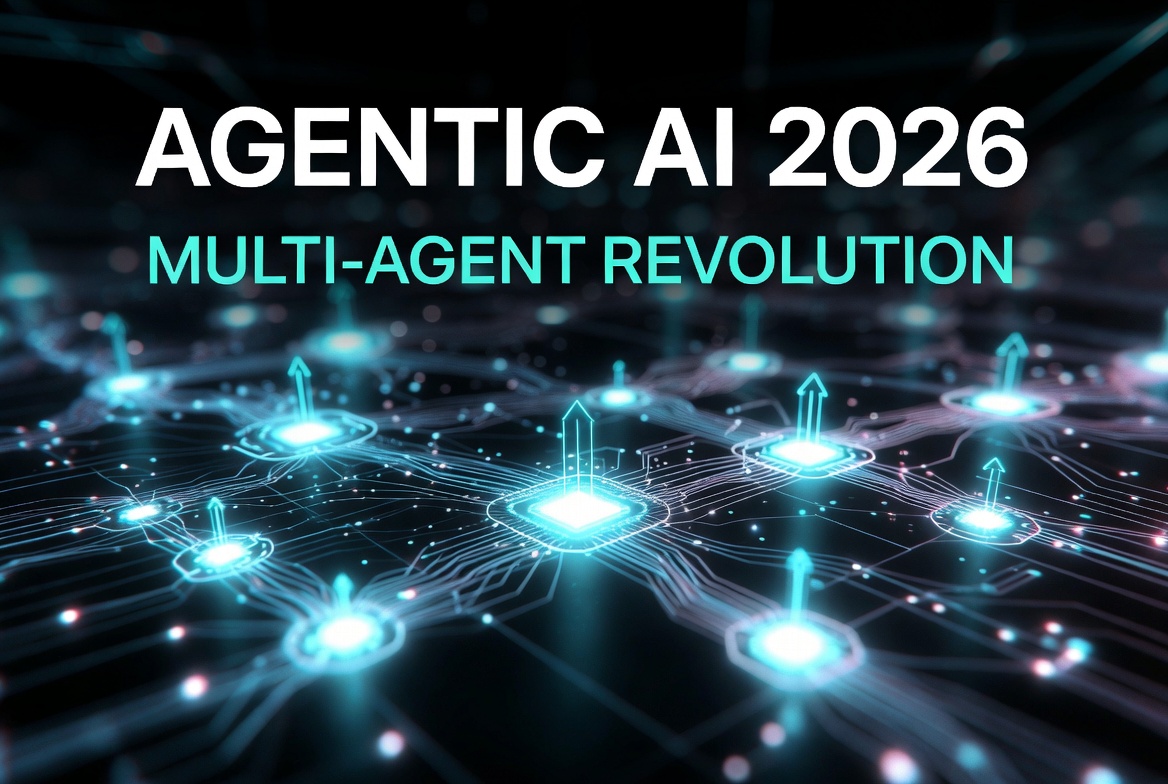
The most powerful implementations in 2026 are multi-agent systems. In these setups, multiple specialized agents work together like a human team. One agent gathers research, another analyzes data, a third creates content or code, and a fourth reviews everything for accuracy and compliance. This collaborative model dramatically improves reliability and allows the system to handle much more sophisticated workflows.
One of the most exciting developments is the ability of multi-agent systems to self-correct. If one agent makes an error, other agents can detect the issue, suggest corrections, and even re-execute tasks. This level of reliability was almost impossible just a year ago. As a result, enterprises are increasingly trusting these systems with mission-critical processes.
Why 2026 Is the Tipping Point
Several key developments converged this year. Leading AI companies released advanced reasoning models with better logical consistency, longer context windows, and reliable tool-calling abilities. New orchestration frameworks and open communication standards made it easier for different agents to work together seamlessly.
According to recent reports, organizations that implemented multi-agent systems in the first quarter of 2026 reported productivity improvements ranging from 40% to 65% in targeted departments. Early adopters in software development, customer service, finance, and supply chain are seeing the fastest returns.
Real-World Applications in 2026
Software development teams are among the biggest beneficiaries. Multi-agent systems now manage complete development cycles — from requirements analysis and architecture design to coding, testing, debugging, documentation, and deployment. Companies report cutting development time by nearly 50% while improving overall code quality.
In customer support, agentic systems handle entire customer journeys from initial contact to problem resolution and follow-up. Healthcare organizations use them for medical literature review, treatment planning, and administrative coordination. Financial institutions deploy agentic AI for fraud detection, compliance monitoring, risk assessment, and personalized investment advice.
The integration of edge AI in modern agentic systems highlights why our Artificial Intelligence category continues to deliver critical forward-looking analysis.
In the legal sector, agentic AI agents are now reviewing contracts, identifying risks, and suggesting clause improvements at speeds previously unattainable by human teams. Similarly, in supply chain management, agents continuously monitor inventory levels, predict disruptions, and automatically reorder supplies while optimizing delivery routes in real time.
As highlighted in Microsoft’s multi-agent systems and AI orchestration framework, modern enterprise AI is shifting from single assistants to coordinated “AI teams” where specialized agents collaborate through orchestration layers to execute complex workflows.
Major Players and Ecosystem Growth
OpenAI, Anthropic, Google DeepMind, Microsoft, and Salesforce have all released powerful agentic frameworks in 2026. Startups specializing in agent orchestration and governance are also seeing explosive growth. The ecosystem is maturing rapidly with new tools for monitoring, auditing, and safely deploying multi-agent systems.
Technical Foundations
As noted in Forbes analysis, agentic AI represents the next major evolution beyond generative AI, enabling truly autonomous business processes.
Several breakthroughs have made this possible:
- Sophisticated orchestration layers
- Advanced reasoning models with improved consistency
- Reliable tool-use and function calling
- Long-term memory and context management
- Standardized protocols for agent-to-agent communication
These technologies allow agents to operate reliably over long periods and handle increasingly complex real-world tasks.
Challenges and Risks
Agentic AI is reshaping job roles across industries. While some routine tasks are being automated, new opportunities are emerging for professionals skilled in agent design, orchestration, monitoring, and governance. The most successful companies are treating agentic AI as an augmentation layer that amplifies human capabilities rather than replacing them.
Readers interested in broader technology developments can explore the full Technology category on Techkip.
Impact on Jobs and the Future of Work
Agentic AI is reshaping job roles across industries. While some routine tasks are being automated, new opportunities are emerging for professionals skilled in agent design, orchestration, monitoring, and governance. The most successful companies are treating agentic AI as an augmentation layer that amplifies human capabilities rather than replacing them.
The Road Ahead
As 2026 progresses, expect faster maturation of multi-agent platforms, better reliability standards, and wider adoption across industries. The combination of agentic AI with robotics, IoT, and other emerging technologies will create entirely new possibilities.
The long-term implications of agentic AI extend far beyond productivity gains. As these systems become more sophisticated, they will fundamentally change organizational structures, decision-making processes, and even the nature of employment. Companies that successfully integrate agentic AI will likely gain substantial competitive advantages in speed, innovation, and cost efficiency.
FAQ – Agentic AI 2026
A: Generative AI creates content from prompts, while agentic AI autonomously plans, executes tasks, and adapts to achieve goals.
A: Yes, many large enterprises have moved them into full production in 2026.
A: Goal misalignment, security issues, and lack of transparency.
A: Stay updated with daily insights by bookmarking Techkip.
Agentic AI in 2026 is more than a trend — it is a fundamental shift in how technology integrates into business and daily work. Organizations that adopt it thoughtfully will gain a significant competitive advantage in the coming years.