
Last Updated on August 1, 2026 by admin
The Workplace Is Entering an AI-Driven Era
For decades, workplace software has helped employees create documents, manage projects, communicate with colleagues, and organize business operations.
Artificial intelligence is now changing that relationship.
Rather than simply providing software tools, modern AI systems are beginning to perform tasks independently, collaborate with employees, and automate routine business processes.
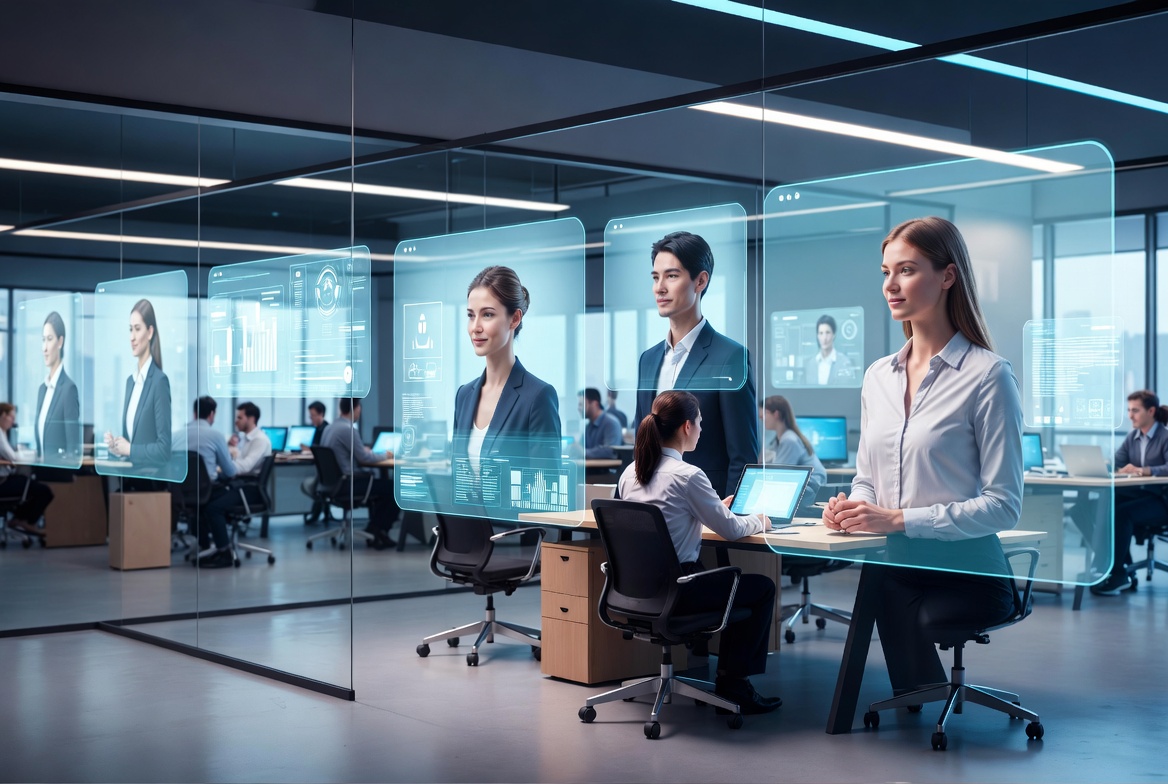
These systems are increasingly being described as AI digital employees—intelligent software agents capable of handling specific responsibilities while working alongside human teams.
Although the technology is still evolving, businesses across multiple industries are exploring how AI agents can improve productivity without replacing human expertise.
🤖 Future Workplace Snapshot: Key Takeaways
- AI digital employees automate repetitive business tasks.
- Human workers remain responsible for strategy, creativity, and decision-making.
- AI agents may improve productivity across many industries.
- Successful adoption depends on transparency, security, and human oversight.
What Are AI Digital Employees?
Unlike traditional automation software that follows predefined rules, AI digital employees can understand context, interpret natural language, analyze information, and complete multi-step tasks with minimal supervision.
Depending on their assigned responsibilities, AI agents may help:
- Schedule meetings
- Summarize lengthy documents
- Draft emails
- Analyze spreadsheets
- Conduct online research
- Prepare reports
- Monitor business workflows
- Organize digital files
Rather than replacing employees, these systems are expected to handle repetitive administrative work while allowing people to focus on more complex responsibilities.
AI Agents Could Become Everyday Colleagues
Imagine starting your workday by asking your AI digital employee to summarize overnight emails, prepare your meeting agenda, update your project dashboard, and identify urgent customer requests. Instead of spending the first hour organizing work, employees could immediately focus on higher-value tasks.
Future workplaces may include both human employees and specialized AI assistants working together.
Microsoft 365 Copilot demonstrates how AI assistants can help automate workplace productivity, document creation, meeting summaries, and business collaboration.
For example:
A marketing manager could ask an AI agent to research competitors, summarize industry news, prepare presentation slides, and organize campaign data before a team meeting.
Instead of switching between multiple applications, employees may simply describe the outcome they need while AI coordinates much of the underlying work.
Intelligent browsing is also becoming an important part of workplace automation. TechKip previously examined this in Why AI Browsers Could Change the Internet, where AI helps users research, summarize, and organize online information more efficiently.
This shift could reduce repetitive administrative tasks while allowing workers to spend more time on planning, creativity, and collaboration.
Every Industry Could Benefit Differently
Google Cloud AI provides enterprise AI solutions that help organizations automate workflows, analyze data, and improve business operations.
The impact of AI digital employees is expected to vary across industries.
Examples include:
| Industry | Potential AI Support |
|---|---|
| Healthcare | Administrative documentation |
| Finance | Data analysis and reporting |
| Education | Lesson preparation |
| Retail | Customer support |
| Manufacturing | Workflow monitoring |
| Logistics | Shipment coordination |
| Legal | Document review |
| Human Resources | Candidate screening |
Rather than replacing professional expertise, AI is likely to enhance existing workflows.
Human Oversight Will Remain Essential
Although AI systems continue improving, important business decisions will still require human judgment.
AI digital employees may recommend actions, organize information, and automate routine processes, but accountability, ethics, creativity, negotiation, and leadership remain human responsibilities.
Organizations adopting AI successfully will likely combine intelligent automation with experienced professionals instead of relying entirely on software.
Digital Employees Need Intelligent Software Platforms
AI digital employees do not work in isolation.
They rely on intelligent operating systems, cloud services, productivity software, enterprise databases, and communication platforms to complete assigned tasks.
TechKip recently explored this evolution in AI Operating Systems Are Redefining the Future of Personal Computing, explaining how intelligent software platforms could coordinate tasks across applications and connected devices.
As these technologies become increasingly interconnected, AI agents will be able to coordinate information across multiple business applications while maintaining consistent workflows.
AI Digital Employees Could Extend Beyond Office Computers
The future workplace is unlikely to be limited to desktop computers and laptops.
AI digital employees may eventually collaborate with workers across smartphones, wearable devices, meeting rooms, factory floors, and remote work environments.
For example, an employee travelling between client meetings could receive summarized project updates through a smartphone, while AI-powered smart glasses display appointment details, navigation instructions, and important reminders without interrupting conversations.
Instead of existing within a single application, AI assistants are expected to become persistent digital collaborators that remain available across multiple devices throughout the working day.
Security and Human Oversight Will Be Critical
Organizations will also need clear policies defining which tasks AI can complete independently and which always require human approval.
As organizations increasingly rely on AI digital employees, maintaining security and accountability will become essential.
Businesses will need clear governance policies covering:
- Data privacy
- User permissions
- AI decision transparency
- Cybersecurity protection
- Regulatory compliance
- Human approval for sensitive decisions
- Continuous monitoring
- Audit trails
Rather than allowing AI systems to operate independently without supervision, organizations are expected to keep people responsible for reviewing important decisions and maintaining accountability.
This balanced approach will help organizations benefit from AI while reducing operational risks.
AI Digital Employees Could Improve Customer Experiences
Beyond internal business operations, AI digital employees may significantly improve customer interactions.
Future AI agents could:
- Answer customer enquiries instantly
- Personalize product recommendations
- Schedule appointments automatically
- Resolve common support requests
- Prepare service documentation
- Route complex issues to human specialists
- Monitor customer satisfaction
- Assist multilingual communication
By handling repetitive service requests, AI can enable human employees to focus on situations requiring empathy, negotiation, and critical thinking.
Wearable Devices Could Become Workplace Companions
Wearable technology is expected to play an increasingly important role in AI-assisted workplaces.
Smart glasses, smartwatches, and future wearable devices could deliver notifications, display live meeting summaries, provide navigation inside large facilities, and support hands-free collaboration.
Rather than replacing computers, wearable devices may become another interface through which AI digital employees communicate with human workers.
TechKip recently explored this evolution in Smart Glasses Are Becoming the Next Major Computing Platform Beyond Smartphones, explaining how AI-powered wearables could become an important extension of future workplace productivity.
Industry Outlook
Artificial intelligence is moving beyond simple chatbots and productivity assistants toward more capable software agents that can manage increasingly complex business workflows.
OpenAI continues developing AI models and agent capabilities that support increasingly sophisticated enterprise automation and workplace productivity.
Over the next several years, organizations are expected to experiment with specialized AI digital employees dedicated to finance, customer service, software development, legal research, healthcare administration, and project management.
Rather than replacing entire professions, these intelligent assistants are more likely to automate repetitive responsibilities while enabling employees to concentrate on strategic planning, innovation, relationship building, and creative problem-solving.
Businesses that successfully combine human expertise with responsible AI adoption are likely to gain significant productivity advantages.
The World Economic Forum regularly examines how artificial intelligence is reshaping employment, workplace skills, and the future of work across global industries.
Challenges Still Need to Be Solved
Despite rapid progress, several important challenges remain before AI digital employees become commonplace.
These include:
- Protecting confidential business information
- Reducing AI hallucinations
- Improving reliability
- Ensuring regulatory compliance
- Building employee trust
- Managing implementation costs
- Integrating legacy software
- Establishing ethical governance frameworks
Addressing these challenges will be essential for widespread enterprise adoption.
TechKip Perspective
AI digital employees represent one of the most significant shifts in workplace technology since the widespread adoption of cloud computing and mobile devices.
The future workplace is unlikely to consist solely of humans or autonomous AI systems.
Instead, successful organizations will combine intelligent software with skilled professionals who provide judgment, creativity, leadership, and accountability.
Businesses that view AI as a collaborative partner rather than a replacement for employees are likely to achieve the greatest long-term value.
Final Thoughts
Artificial intelligence is steadily transforming workplace software from passive productivity tools into intelligent digital collaborators.
AI digital employees have the potential to automate repetitive tasks, improve business efficiency, support decision-making, and simplify everyday workflows across many industries.
Although important challenges remain, advances in enterprise AI, intelligent operating systems, cloud platforms, and wearable computing suggest that digital employees will become an increasingly familiar part of the modern workplace.
Rather than replacing human workers, AI is likely to become another valuable member of tomorrow’s business teams.
Frequently Asked Questions
AI digital employees are intelligent software agents capable of completing business tasks such as scheduling, document summarization, research, reporting, and workflow automation with varying levels of autonomy.
Most organizations are expected to use AI to complement human employees by automating repetitive work while leaving strategic decision-making, creativity, and leadership to people.
Healthcare, finance, manufacturing, logistics, education, legal services, retail, and customer support are among the industries expected to benefit from AI-assisted workflows.
Organizations must address privacy, cybersecurity, transparency, governance, reliability, regulatory compliance, and employee trust before AI digital employees become widely adopted.