


Last Updated on August 12, 2026 by admin
Artificial intelligence has become remarkably good at understanding words, images, code and increasingly complex digital environments. But the physical world remains a much harder problem.
A person can walk into a room and instantly understand that a glass sitting near the edge of a table could fall, that a chair is blocking a path, or that someone reaching toward an object may be about to pick it up.
For a robot, those seemingly obvious observations can require enormous amounts of computation and training.
That is where AI world models are becoming increasingly important.
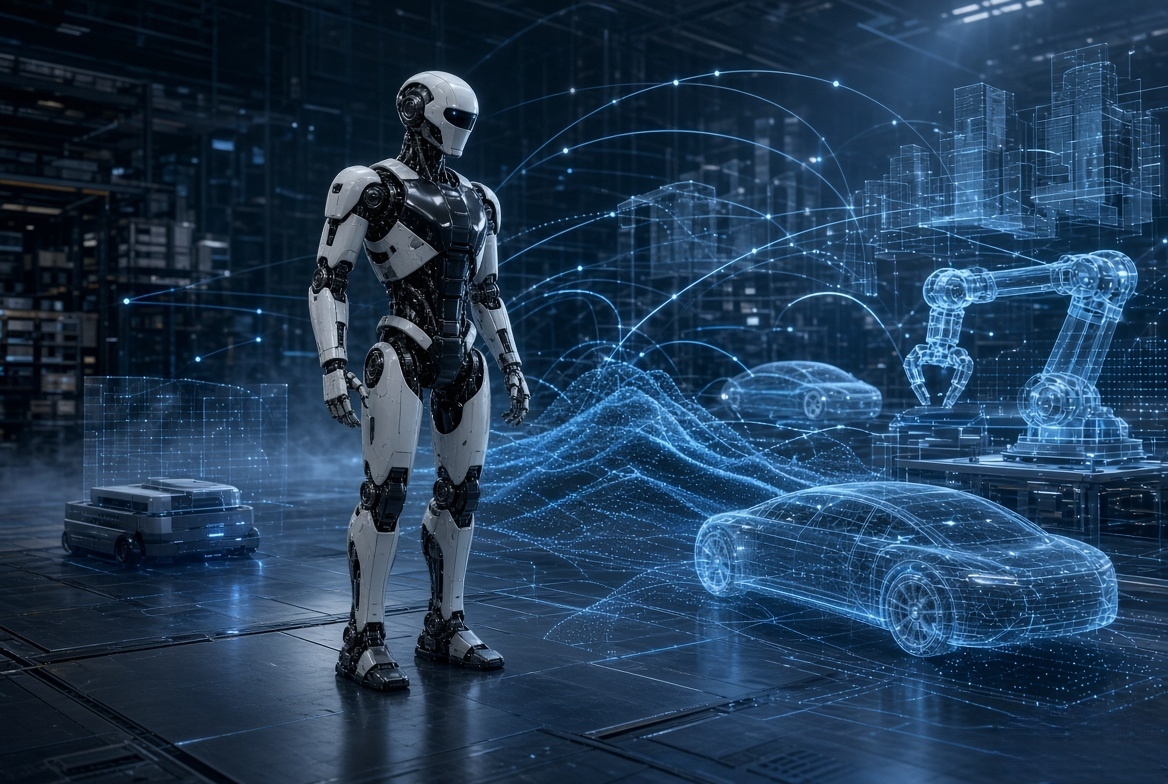
Instead of simply recognizing what is in front of them, world models attempt to build an internal representation of how an environment works. They can help an AI system understand what it is seeing, predict what might happen next and estimate how an action could change the environment.
The technology could become one of the most important foundations of physical AI.
NVIDIA’s Cosmos 3, for example, combines physical reasoning, world generation and action generation for physical-AI applications. Google DeepMind is pursuing a related direction with Genie 3, a world model capable of generating interactive environments that can be explored in real time.
If these systems continue improving, future robots may no longer need to learn every physical situation individually.
They could learn to understand the world itself.
Future Technology Snapshot: Key Takeaways
- AI world models attempt to represent and predict how physical environments behave.
- They could help robots anticipate events instead of merely reacting to them.
- Synthetic environments could dramatically increase the amount of training available to autonomous machines.
- World models could improve humanoid robots, autonomous vehicles, drones and industrial systems.
- NVIDIA Cosmos 3 is combining world generation, reasoning and action capabilities for physical AI.
- Google DeepMind’s Genie 3 demonstrates increasingly interactive AI-generated environments.
- The technology could reduce some of the cost and difficulty of collecting real-world robotics training data.
- Reliability, physical accuracy, compute requirements and safety remain significant challenges.
- World models could eventually become a foundational layer for physical AI.
What Is an AI World Model?
A world model is an AI system designed to build an internal understanding of an environment and how that environment changes over time.
Traditional computer vision systems might identify a person, a vehicle or a piece of furniture.
A world model aims to go further.
It could potentially understand relationships between objects, movement, cause and effect, spatial structure and possible future outcomes.
Consider a warehouse robot approaching a crowded aisle.
A conventional vision system might identify a worker standing ahead.
A more sophisticated world model could attempt to predict that the worker is moving toward another shelf, estimate where the person is likely to go next and determine whether the robot should slow down or choose another route.
That predictive capability is critical for physical AI because the real world is constantly changing.
NVIDIA’s Cosmos 3 is one of the clearest examples of this direction, combining world generation, physical reasoning and action generation for applications including robotics and autonomous vehicles.
The rise of personal robots could make this technology even more important as robots move from controlled industrial environments into unpredictable homes.
Why Robots Need More Than Computer Vision
Computer vision has already transformed robotics.
Cameras allow machines to recognize objects, detect people and understand basic surroundings.
But recognition alone is not enough.
A robot operating in the real world needs to answer questions such as:
What is going to happen next?
What happens if I move this object?
Can I safely walk through this space?
Will this surface support my weight?
What will happen if a person suddenly changes direction?
These questions involve prediction rather than simple recognition.
The idea becomes particularly powerful when combined with the rise of personal robots, which could use world models to understand rooms, objects and changing situations rather than relying only on fixed instructions.
TechKip has already explored how AI-powered personal robots could become a new generation of household technology, but world models add another layer to that story.
They could provide robots with something closer to an internal simulation of the environments they operate in.
World Models Could Become Digital Simulators of Reality
One of the most interesting applications of world models is simulation.
Training a physical robot in the real world is expensive.
Every mistake can damage hardware, interrupt operations or create safety risks.
A simulated environment offers a safer alternative.
A robot could potentially practise thousands of movements inside virtual environments before performing them on physical hardware.
Google DeepMind’s Genie 3 demonstrates the broader potential of this approach. The system can generate interactive environments from text descriptions, with environments that can be explored in real time. Google DeepMind describes world models as systems capable of simulating aspects of the world so agents can predict how environments evolve and how their actions affect them.
This approach also connects with the emerging concept of AI digital twins, where intelligent systems maintain increasingly detailed representations of people, environments and workflows.
The long-term possibility is compelling.
Instead of training a robot only in one physical warehouse, developers could expose it to thousands of simulated warehouses.
Instead of teaching an autonomous vehicle to respond to one road scenario, developers could generate thousands of variations involving weather, lighting, traffic and unexpected events.
Simulation could therefore become an enormous training multiplier.
From Digital AI to Physical AI
Most consumer AI today operates inside digital environments.
AI can write an email, summarize a document, generate an image or analyse code without physically interacting with the world.
Robots face a different challenge.
They need to turn intelligence into physical action.
That means AI must connect perception, reasoning and movement.
This transition from digital AI to physical AI could become one of the defining technology shifts of the next decade.
The concept represents a similar shift to the one already occurring in software, where AI browsers are moving from simply displaying information toward understanding context and taking actions on a user’s behalf.
The difference is that physical AI has consequences in the real world.
A wrong answer from a chatbot may be inconvenient.
A wrong decision by a factory robot or autonomous vehicle could be dangerous.
That makes predictive world understanding particularly valuable.
Where World Models Could Be Used
NVIDIA’s broader Cosmos platform shows how world foundation models can support robot learning, autonomous-vehicle training and video-based AI systems. The potential applications extend well beyond humanoid robots.
Humanoid Robots
Humanoid robots operating in homes, offices and factories could use world models to understand unfamiliar environments.
A robot entering a kitchen, for example, could identify objects and reason about their relationships rather than following a rigid map.
Autonomous Vehicles
Self-driving systems need to predict the movements of pedestrians, cyclists, vehicles and other road users.
World models could help generate and evaluate difficult scenarios before autonomous systems encounter them on public roads.
Manufacturing
Factories contain highly structured environments, making them attractive targets for physical AI.
Robots could learn how objects move through production lines, anticipate equipment behaviour and respond to unexpected changes.
Warehouses
Warehouse robots must navigate constantly changing environments filled with workers, shelves, packages and moving machinery.
World models could help these systems predict congestion and optimise routes.
Drones
Drones operate in environments where movement is three-dimensional and conditions can change quickly.
Drones could benefit because a world model could help an autonomous aircraft anticipate obstacles, changing weather conditions and the movement of people or other vehicles.
This could be especially important for delivery, inspection, mapping and emergency-response applications.
Smart Infrastructure
World models could eventually support intelligent buildings, transportation networks and industrial facilities.
Rather than individual sensors simply reporting events, AI systems could build a broader understanding of how an environment behaves.
The Computing Power Behind World Models
There is a major challenge behind all of this intelligence: computation.
World models need to process enormous amounts of visual, spatial and temporal information.
Training them can require substantial computing resources.
Running them in real time can be even more demanding.
This makes specialised AI chips, high-performance data centres and efficient inference systems increasingly important.
Training these models requires enormous computing resources, making the rapid expansion of AI-focused cloud infrastructure another important part of the physical-AI transition.
TechKip’s coverage of the AI cloud-computing race highlights how the industry is investing heavily in infrastructure designed to support increasingly demanding AI workloads.
Over time, some world-model processing could move closer to the edge.
Robots, vehicles and drones may need to make decisions locally rather than waiting for a remote cloud server.
That creates another engineering challenge: achieving sophisticated physical reasoning within tight power, memory and latency constraints.
Why Synthetic Data Could Change Robotics
One of the biggest problems in robotics is data.
AI systems generally become better with more training examples.
But collecting physical robotics data is difficult.
A human may need to demonstrate a task repeatedly.
A robot may need thousands of attempts to learn a movement.
Real-world environments are expensive to recreate.
World models could help solve part of this problem by generating synthetic training environments.
Instead of waiting for a robot to encounter an unusual situation, developers could create simulated versions of that situation.
NVIDIA’s Cosmos platform is designed around this broader concept, supporting world-model-based simulation and synthetic data generation for robotics, autonomous vehicles and industrial applications.
The result could be a much larger training universe.
A robot could experience virtual versions of environments that would be rare, expensive or dangerous to reproduce physically.
World Models Could Make Robots More Adaptable
Today’s robots are often highly capable within specific environments.
A factory robot can perform a particular task extremely well.
But moving that robot into an unfamiliar environment can require substantial retraining.
World models could eventually make robots more adaptable.
If a robot develops a general understanding of physical relationships, it may be able to transfer knowledge between environments.
For example, the concept of gravity does not change simply because a robot moves from one room to another.
Neither does the basic relationship between a heavy object and a fragile surface.
A sufficiently capable world model could potentially encode these general principles and apply them across many environments.
This is one reason researchers see world models as potentially important for more general-purpose physical AI.
The Safety Problem Becomes Bigger
Greater autonomy also creates greater responsibility.
A robot that understands and predicts its environment can make more decisions independently.
But what happens when its prediction is wrong?
World models are not perfect simulations of reality.
They can make incorrect assumptions, miss unexpected events or generate inaccurate predictions.
That means physical AI systems will require strong safety mechanisms.
Developers may need to combine world models with traditional sensors, explicit safety rules, redundant systems and human oversight.
The goal should not be to assume that an AI model will always understand reality correctly.
Instead, systems need to be designed to fail safely when uncertainty is high.
This distinction could become extremely important as robots move from laboratories into homes, roads and public spaces.
The Biggest Challenge: Reality Is Messy
Virtual environments can be controlled.
The real world cannot.
A simulation may accurately represent a room under normal conditions but struggle with unusual situations.
A plastic bag could blow across a road.
A child could suddenly run into a robot’s path.
An object could break when picked up.
A wet floor could behave differently from the training data.
These edge cases represent one of the central challenges for physical AI.
The world is full of exceptions.
World models must therefore become increasingly robust rather than simply more visually impressive.
The best system will not necessarily be the one that generates the most realistic virtual environment.
It may be the one that correctly predicts what matters when conditions become unpredictable.
Industry Outlook
The world-model race is becoming an important part of the broader physical-AI competition.
NVIDIA is positioning Cosmos as a platform for world foundation models, synthetic data and physical-AI development, while Google DeepMind continues advancing interactive world simulation through Genie.
The technology is still developing, and it would be premature to assume that today’s systems can provide human-level physical understanding.
However, the direction is significant.
AI development is gradually moving beyond models that understand digital information toward systems designed to understand environments, predict events and generate actions.
That shift could accelerate robotics, autonomous transportation and industrial automation.
The next major milestone will likely be proving that these models can improve real-world performance rather than simply producing impressive demonstrations.
TechKip Perspective
The most interesting aspect of AI world models is that they could change what we expect from intelligent machines.
For years, AI development focused heavily on language and digital information.
Now the industry is increasingly asking a different question:
Can AI understand the physical world well enough to act inside it?
That is a much harder challenge.
A chatbot can generate a convincing description of a cup.
A robot needs to know where the cup is, how heavy it might be, whether it is fragile, how to grasp it and what could happen if it drops it.
That requires perception, reasoning, prediction and physical action to work together.
World models could become the connective layer between those capabilities.
At TechKip, we believe this may eventually prove more consequential than another incremental improvement in conversational AI.
If world models become reliable enough, robots may evolve from machines that follow instructions into systems that understand situations.
That could open the door to genuinely adaptive machines.
Conclusion
AI world models represent an important new direction in artificial intelligence.
Rather than simply recognising objects or generating content, these systems attempt to model how environments behave and how actions can change them.
That capability could become essential for the next generation of physical AI.
Humanoid robots could use world models to navigate unfamiliar homes.
Autonomous vehicles could simulate difficult road scenarios.
Drones could anticipate changing environments.
Factories could train robots inside realistic virtual facilities.
And developers could use synthetic environments to dramatically expand the amount of training available to physical machines.
The technology is still far from perfect.
Computing costs, simulation accuracy, latency, safety and unpredictable real-world conditions remain substantial obstacles.
But the trajectory is becoming increasingly clear.
AI is moving from understanding the digital world toward understanding the physical one.
If that transition succeeds, the next generation of robots may not simply see the world.
They may begin to model it, predict it and act within it.
Frequently Asked Questions
An AI world model is a system designed to represent an environment and predict how that environment may change over time, helping AI agents reason about possible actions and outcomes.
Robots operate in unpredictable physical environments. World models could help them understand objects, anticipate events and choose actions rather than simply reacting to what they see.
NVIDIA Cosmos is a platform built around world foundation models for physical AI. NVIDIA says its technology supports applications including robotics, autonomous vehicles and industrial vision systems.
Genie 3 is a general-purpose world model from Google DeepMind that can generate interactive environments from text and allow users or AI agents to explore them in real time.
Not necessarily. World models could increase robot autonomy, but reliable physical AI will still require sensors, safety systems, specialised control mechanisms and appropriate human oversight.
Yes. One potential application is generating and simulating complex driving scenarios so autonomous systems can be trained and evaluated against a wider range of conditions.
Yes. Research and commercial systems already exist, but today’s world models remain limited compared with the complexity and unpredictability of the real world.
One of the biggest challenges is achieving reliable predictions in unfamiliar and unpredictable situations while keeping the computational cost and latency low enough for real-world applications.