


Last Updated on September 23, 2026 by Michael Motha
Drones are entering a new stage of development. The next major breakthrough may not be a faster motor, a larger battery or a more powerful camera, but the ability to operate safely beyond the direct view of a human pilot.
Beyond Visual Line of Sight, commonly called BVLOS, is becoming one of the most important technologies in the commercial drone industry. It could allow drones to travel much farther, support large-scale inspections, deliver medical supplies, monitor infrastructure and operate in emergency situations without requiring an operator to physically see the aircraft throughout the flight.
That shift matters because most of the biggest commercial opportunities for drones require more than short-range flights. A drone inspecting a pipeline, delivering medicine between hospitals or surveying a large agricultural area cannot always remain within a pilot’s visual range.
Recent developments show that the technology and regulatory ecosystem are gradually moving toward more scalable operations. In August 2026, the Federal Aviation Administration expanded its BEYOND program to support more advanced drone operations and address remaining challenges around BVLOS, public safety and complex airspace environments. The agency said the first phase had already generated more than 70,000 flights, including more than 48,000 BVLOS operations.
Drone Snapshot: Key Takeaways
- BVLOS allows drones to operate beyond the direct visual range of their pilots.
- Airspace management is becoming as important as the drone itself.
- Automation, sensors, communications and detect-and-avoid systems are critical to safe BVLOS operations.
- Commercial opportunities include delivery, infrastructure inspection, agriculture and emergency response.
- Regulation remains one of the biggest factors determining how quickly large-scale operations can expand.
- Future drone networks could combine autonomous aircraft with digital traffic-management systems.
Why BVLOS Could Change the Drone Industry
Traditional drone operations often depend on a simple limitation: the pilot must be able to see the aircraft.
That requirement makes sense from a safety perspective, but it also limits the distance, scale and economic potential of many drone applications.
Consider infrastructure inspection. A single power-line corridor, railway network or pipeline can stretch for hundreds of kilometres. Requiring an operator to remain close enough to visually monitor a drone can make the operation expensive and difficult to scale.
BVLOS changes that equation.
Instead of treating every flight as a short-range mission, operators can begin thinking about drones as part of a larger transportation and data network.
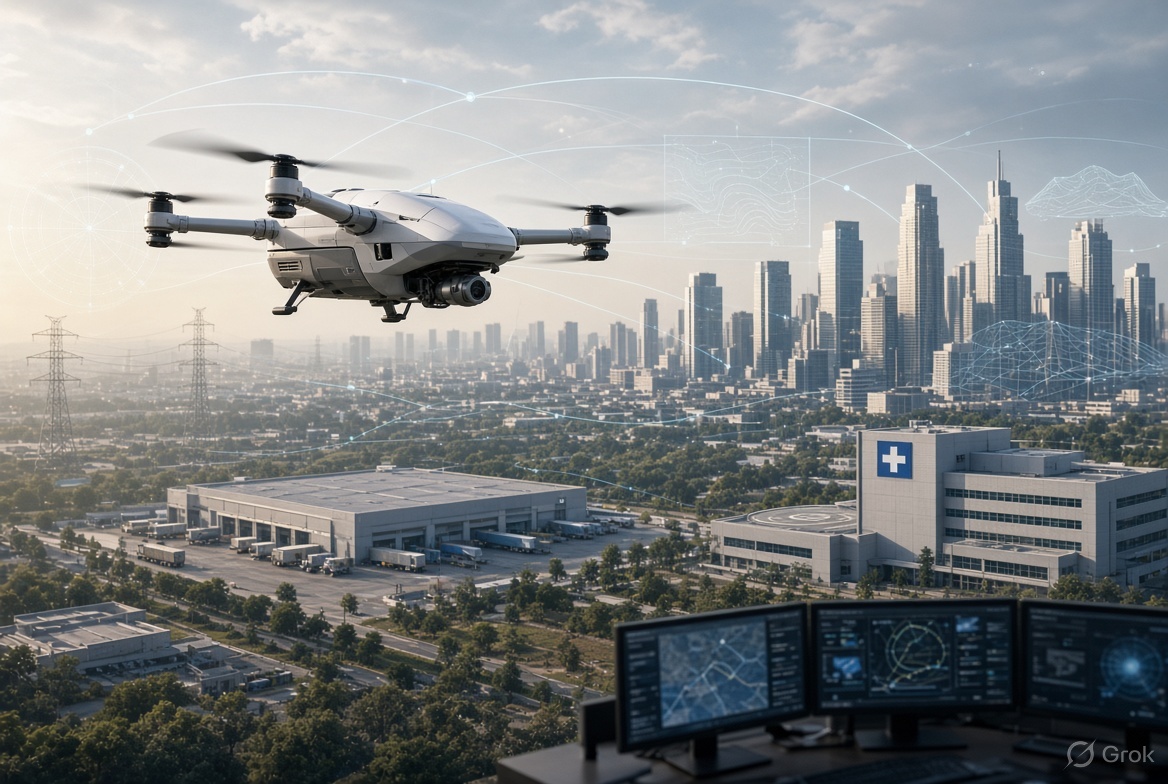
The aircraft becomes one component of a system that includes navigation, communications, sensors, remote operators, airspace-management services and automated safety technologies.
That is why BVLOS is more significant than simply allowing drones to fly farther.
It represents a transition from individual drone flights toward connected aerial operations.
The Technology Behind BVLOS Flight
Flying a drone beyond the pilot’s visual range requires considerably more than GPS.
A BVLOS aircraft needs reliable navigation, communications and sensing systems capable of handling situations that a nearby human pilot might normally manage.
Computer vision and other sensors can help detect obstacles. Navigation systems can maintain the planned route. Communications networks can transmit aircraft status and operational information. Automated flight-control systems can react quickly when conditions change.
The aircraft also needs ways to understand its surroundings and determine whether another aircraft or obstacle presents a risk.
This is where autonomous decision-making becomes increasingly important.
TechKip’s previous coverage of AI world models and physical intelligence examined how machines could build richer representations of physical environments. Similar concepts could eventually become important for drones that need to predict obstacles, understand changing surroundings and make rapid navigation decisions.
The important distinction is that autonomy does not necessarily mean removing humans from the process.
A commercial drone network can still involve human supervision while using automation to handle routine navigation, monitoring and safety functions.
Airspace Management May Be the Real Breakthrough
The drone itself is only half of the problem.
If thousands of drones eventually operate across cities, industrial areas and rural regions, they cannot simply fly independently without coordination.
This creates the need for Unmanned Aircraft System Traffic Management, or UTM.
The FAA describes UTM as a collaborative ecosystem designed to support safe drone operations through functions such as flight planning, authorization, surveillance and conflict management. The agency says UTM is particularly important for BVLOS operations.
NASA has also spent years developing technologies for managing drones beyond visual line of sight. Its research on NASA’s BVLOS research has focused on digitally sharing flight information, strategic deconfliction and maintaining situational awareness when multiple operators share low-altitude airspace.
This means the future of drones could look less like isolated aircraft and more like a digital transportation network.
A drone might request a route, receive authorization, share its position with relevant systems and automatically adjust its flight when another operation creates a conflict.
From Delivery Drones to Infrastructure Networks
Drone delivery is one of the most visible examples of BVLOS technology, but it is only one application.
TechKip’s earlier analysis of autonomous delivery drones and the future of logistics explored how drones could eventually handle time-sensitive and lightweight shipments.
BVLOS could make those operations more practical by allowing aircraft to travel beyond the range of a nearby pilot.
The same principle applies to infrastructure.
Energy companies could use drones to inspect transmission lines. Rail operators could monitor tracks. Telecom companies could survey towers. Mining companies could inspect large sites. Agricultural operators could monitor crops over extensive areas.
In these cases, the value is not necessarily the drone itself.
The value comes from collecting information over large areas more quickly and potentially at lower operating cost.
Why Autonomy Matters for Long-Distance Drone Operations
A human operator can control a drone effectively during many short flights.
Scaling that model to hundreds of aircraft is much harder.
If every aircraft requires continuous manual attention, the economics of large-scale drone networks become difficult.
Automation can reduce that workload.
A drone could follow an approved route, monitor its own flight parameters, detect anomalies and alert a remote operator when human intervention is required.
This model resembles the way modern computing systems already operate. Humans establish objectives and rules while software handles many routine processes automatically.
The same concept could eventually allow one trained operator to supervise multiple drones, although the exact operational model will depend on regulation, risk level and the technology used.
Edge Computing Gives Drones Faster Decisions
Autonomous drones also face a fundamental computing problem: decisions often need to happen immediately.
A drone approaching an unexpected obstacle cannot always wait for a remote cloud server to process camera footage and return an instruction.
Local processing can therefore become increasingly important.
TechKip’s coverage of on-device AI in smartphones explored the broader shift toward processing artificial intelligence tasks locally rather than sending every request to the cloud.
The same principle applies to drones.
Onboard processors can analyse sensor data, identify obstacles and support navigation decisions without depending entirely on a remote connection.
Cloud infrastructure will still matter for fleet management, historical analysis, mapping and large-scale data processing. But safety-critical reactions increasingly need to happen close to the aircraft.
Batteries Still Set the Physical Limits
Autonomy can make drones smarter, but intelligence cannot eliminate the physics of flight.
A drone still needs enough energy to reach its destination, complete its mission and return safely or reach an alternative landing location.
Battery capacity therefore remains one of the most important constraints on commercial drone operations.
Flight duration, payload weight, weather conditions and reserve requirements all influence the practical range of an aircraft.
Research into next-generation energy storage could eventually help.
TechKip has previously explored quantum batteries and next-generation energy storage as part of the broader effort to rethink how energy can be stored and delivered.
For drones, even incremental improvements in energy density could have significant consequences because additional battery capacity can translate into longer missions, larger payloads or greater operational flexibility.
The Data Layer Is Becoming Just as Important
Every autonomous drone can generate enormous amounts of information.
Cameras, thermal sensors, radar, positioning systems and other instruments can produce continuous streams of operational data.
For a single drone, that may be manageable.
For a fleet, it becomes a data-management challenge.
This is where cloud data platforms for enterprise analytics become relevant. Large drone operators may eventually need systems capable of collecting, processing and analysing data from hundreds or thousands of aircraft.
The most valuable drone companies may therefore not simply be the ones producing aircraft.
They may also be the companies building the software, communications, analytics and infrastructure that allow those aircraft to work together.
Regulation Will Determine How Fast BVLOS Scales
The technology is advancing, but regulation remains critical.
In the United States, current Part 107 rules continue to define many small-UAS operating requirements, while BVLOS operations can require additional approvals or waivers depending on the operation.
The FAA’s BEYOND program is designed to gather operational experience and develop a framework for more scalable drone integration. The agency’s August 2026 announcement said Phase 2 would expand participation and help address remaining challenges to routine drone operations.
The broader direction is important.
Instead of treating every advanced drone operation as an isolated experiment, regulators and industry are working toward systems that could eventually support repeatable and scalable operations.
That transition will require evidence that automated aircraft can operate safely around other drones, helicopters, airplanes, buildings, people and critical infrastructure.
Drone Swarms Add Another Layer of Complexity
BVLOS becomes even more interesting when multiple autonomous drones operate together.
In September 2026, the UK’s Defence Science and Technology Laboratory announced that the British Army had completed a realistic UK drone-swarm demonstration using a software-defined swarm capability test bed.
Although military applications are different from commercial drone services, the underlying technologies overlap in important areas.
Coordinated navigation, communications, autonomous decision-making and distributed control could all become useful in civilian operations.
For example, a future emergency-response system could potentially deploy several drones to map a disaster zone, inspect damaged infrastructure and relay information to responders.
The technology does not require every drone to perform the same task.
Instead, multiple aircraft could coordinate their activities while a human team supervises the overall mission.
The Next Drone Race Is About Infrastructure
The first phase of the drone industry focused heavily on aircraft.
Better cameras, longer flight times and improved stabilization helped establish the market.
The next phase may focus more heavily on infrastructure.
Companies will need reliable charging systems, communications networks, digital maps, traffic-management services, secure data platforms and automated safety technologies.
Cities may eventually need designated landing areas and operational zones.
Businesses may need software capable of managing fleets rather than individual aircraft.
Regulators will need ways to verify that autonomous systems can safely share airspace.
In other words, the future drone industry could increasingly resemble an aviation technology ecosystem rather than a consumer electronics market.
Industry Outlook
The commercial drone industry is moving toward a more connected model in which aircraft, software, sensors, communications and airspace systems work together.
The expansion of the FAA’s BEYOND program is one indication of this transition, while NASA’s ongoing work on airspace integration demonstrates that traffic management is becoming a central part of drone technology development.
At the same time, demonstrations such as the UK’s recent swarm trials show how quickly autonomous coordination is progressing.
The immediate future is unlikely to consist of completely independent fleets flying everywhere without human supervision.
A more realistic path is gradual automation.
Drones will increasingly handle routine navigation and monitoring while human operators remain responsible for higher-level decisions, exceptions and safety oversight.
That model could eventually unlock commercial applications that are difficult to operate economically today.
TechKip Perspective
The most important development in drone technology may not be the drone itself.
The real breakthrough could be the creation of an environment in which autonomous aircraft can operate safely at scale.
BVLOS is therefore more than a technical feature. It is a gateway technology connecting autonomous flight, artificial intelligence, airspace management, edge computing, cloud analytics and advanced energy storage.
If regulators can establish scalable safety frameworks and manufacturers can continue improving reliability, drones could move from isolated missions to persistent aerial services.
That could mean routine infrastructure inspections, emergency-response networks, remote-area deliveries and large-scale environmental monitoring.
The winning model will not necessarily be the drone with the longest flight time or the most advanced camera.
It may be the ecosystem that can make autonomous flight dependable, economical and easy to integrate into existing operations.
Conclusion
Drones are moving beyond the era in which their usefulness was measured primarily by how far a human could see them.
The emerging BVLOS era is about something much larger: creating a connected aerial infrastructure capable of supporting autonomous aircraft over greater distances.
The technology still faces important challenges involving safety, regulation, communications, batteries, cybersecurity and public acceptance.
But the direction is becoming clearer.
As airspace-management systems mature and autonomous navigation becomes more reliable, drones could evolve from individual flying machines into a new layer of digital infrastructure.
The future of drones may not simply be about flying farther.
It may be about flying intelligently, coordinating safely and operating at a scale that was previously impossible.