


Last Updated on November 7, 2026 by Michael Motha
A conventional drone operation usually follows a simple pattern: a pilot prepares the aircraft, travels to the location, launches it, captures footage and returns. This works well for planned photography and inspections, but it can be inefficient when an organisation needs repeated aerial checks throughout the day or rapid visual information after an unexpected event.
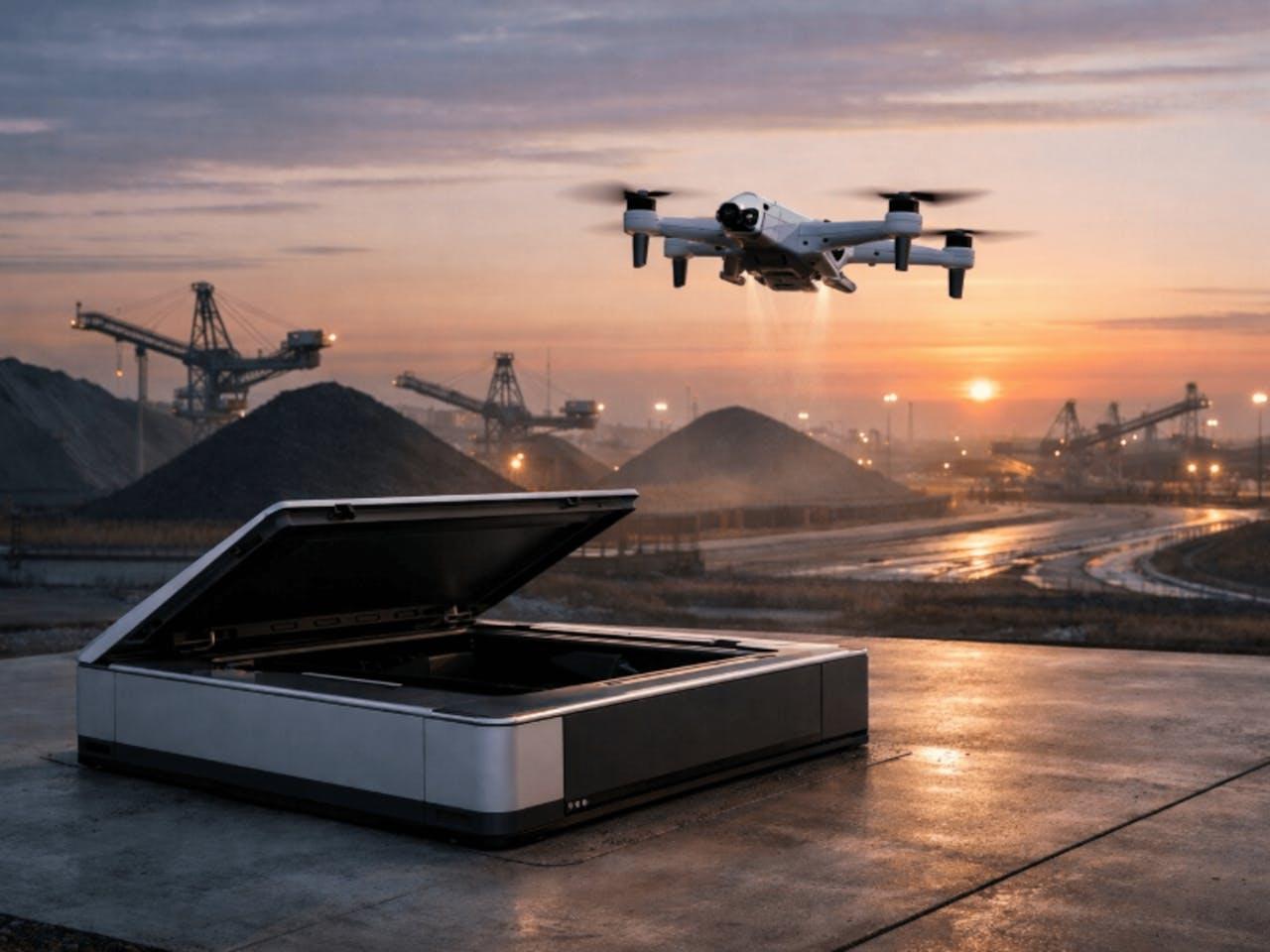
A drone-in-a-box system changes that workflow. The aircraft is stored and protected inside a ground-based dock, which can provide charging, communications, weather monitoring and automated launch support. Once a mission is authorised, the drone can take off, capture information and return to its docking station without requiring a pilot to stand beside the aircraft throughout the entire process.
The latest development is the DJI Dock 4, announced in October 2026. DJI says the system introduces automated battery swapping in approximately 25 seconds and is designed to support continuous aerial operations. Its Matrice 5TD aircraft combines wide-angle and infrared cameras with additional sensing technologies. These are manufacturer specifications, not independent performance guarantees, but they illustrate the direction of automated aerial imaging.
The larger story is not simply a new drone accessory. It is the emergence of camera-equipped aerial systems that can be stationed near the places they monitor and dispatched when visual information is needed.
Drone Cameras: Key Takeaways
- Drone-in-a-box systems allow aircraft to be stored, managed and deployed from automated docking stations.
- Automated battery management can reduce the time between consecutive missions.
- Camera-equipped drones can support inspections, construction monitoring, emergency response and remote-site observation.
- Cloud platforms help organisations manage aerial footage, flight records and inspection information.
- AI can assist with selected detection and monitoring tasks, but human oversight remains essential.
- Aviation regulations, privacy, cybersecurity and operating costs must be considered before deployment.
How Automated Drone Docks Work
A drone dock is more than a storage box. It acts as a managed operating point for an aircraft. Depending on the system, it may include a weather-resistant enclosure, landing platform, charging or battery-management equipment, network connectivity and remote monitoring software.
A typical workflow begins with a scheduled inspection or an authorised alert. The operator or approved software initiates a mission. The dock opens, the aircraft takes off and follows a planned route. During the flight, its camera sends images or a live video feed to the control platform. Once the mission is complete, the aircraft returns and lands on the dock.
The system can then transfer captured data, recharge or replace the battery, run status checks and prepare for another authorised mission.
Battery management is especially important. A drone that must remain grounded for a lengthy recharge cannot provide uninterrupted coverage. DJI says Dock 4 can automatically swap a battery in approximately 25 seconds under its stated test conditions. Its support documentation also describes a turnaround interval of less than 45 seconds between consecutive operations, measured from landing to the next take-off. Actual deployment performance will depend on the environment, aircraft condition, mission requirements and operating procedures.
This does not mean a drone can fly indefinitely. Aircraft still have flight-time limits, maintenance needs and weather restrictions. The dock reduces one source of downtime; it does not remove every operational limitation.
Why Camera Technology Is Central to Automated Drone Monitoring
The value of an automated drone depends on the information it can collect. A system that launches quickly but delivers poor images or unreliable data will have limited practical value.
For many monitoring tasks, a high-quality visible-light camera is the starting point. It can provide wide-area views of buildings, roads, construction sites, industrial facilities and other assets. Zoom cameras can help operators inspect specific details without bringing the aircraft too close to the subject.
Thermal imaging adds another layer. It can show temperature patterns that are not visible in ordinary photographs, potentially helping trained inspectors identify areas that need closer examination. This can be useful around electrical infrastructure, solar installations and industrial equipment.
Some enterprise aircraft combine these camera feeds with ranging and obstacle-sensing technologies. The purpose is not to turn every drone into a complex laboratory. It is to help the aircraft navigate its environment and give operators more useful information.
For a deeper look at the wider camera transition, TechKip has explored how AI-powered drones are becoming intelligent networks, not just flying cameras. Automated docks extend that idea by changing not only what a drone can observe, but also how frequently and quickly it can be deployed.
Where Always-Ready Aerial Cameras Could Make a Difference
Industrial Sites and Infrastructure
Large industrial facilities contain equipment, access roads, storage areas and structures that may need regular visual checks. A docked drone could be dispatched to inspect a particular location or provide an overview after an alert.
For infrastructure operators, the benefit may be faster access to visual evidence. A team could assess a reported issue before deciding whether technicians need to travel to the site. This may improve prioritisation, although any safety-critical finding still requires appropriate human assessment.
Construction and Project Monitoring
Construction sites change continuously. Regular aerial images can help project managers document progress, identify visible changes and maintain a record of site conditions.
A dock-based system could capture images at scheduled intervals, giving teams a more consistent visual record. However, the value depends on repeatable flight paths, comparable camera angles, suitable weather and a clear process for reviewing the results.
Emergency Response
When an incident occurs, responders often need a quick overview of the affected area. A nearby docked drone could provide aerial imagery to help teams understand access routes, visible damage or changing conditions.
DJI positions Dock 4 for public safety and emergency-response workflows. Its announcement describes rapid deployment and live video transmission, but the practical benefit will depend on local permissions, network coverage, weather and the emergency organisation’s procedures.
Remote Facilities and Perimeter Monitoring
Some facilities cover large areas or operate outside normal business hours. A drone may be used to investigate a sensor alert, inspect a remote section of a site or provide a temporary aerial view for a security team.
This should not be confused with unrestricted autonomous surveillance. Camera use must respect privacy laws, property rights, airspace rules and the organisation’s own security policies.
From Scheduled Flights to Event-Driven Camera Missions
One of the most interesting changes is the move from flights that happen only at fixed times to missions triggered by events.
For example, a facility might receive an alert from a perimeter sensor, fire alarm or equipment-monitoring system. An authorised operator could use that information to dispatch a drone to the relevant area. The camera could then provide a live view, helping the response team decide what to do next.
This approach is sometimes described as dock-as-first-responder. It does not mean the drone independently decides how to respond to an emergency. Rather, the dock and connected software can reduce the time needed to get an aircraft into the air after an authorised instruction.
The software layer is essential. It must connect alerts, mission planning, aircraft status, camera feeds and operator permissions. Without that coordination, an automated dock is little more than a convenient place to store a drone.
AI can assist by identifying selected objects or highlighting unusual activity in a video feed. However, automated detection can produce false alerts or overlook important details. Human operators should remain responsible for interpreting significant findings and deciding what action is appropriate.
The Cloud Is Becoming the Control Centre for Aerial Cameras
A network of docked drones can generate substantial amounts of video, photographs, flight records and inspection data. Managing that information requires more than a live-video screen.
Cloud platforms can help organisations store footage, organise missions, manage user access and review records from multiple locations. A maintenance team might compare images from successive inspections, while a project manager checks progress across several sites.
The cloud can also make collaboration easier. An operator in one location may launch an authorised mission while a specialist elsewhere reviews the video or inspection results. This can reduce the need for every expert to travel to every site.
But cloud dependence creates questions about connectivity, data ownership and security. Organisations should understand where footage is stored, whether it is encrypted, who can access it and how long records are retained. They should also plan for network outages and decide which functions must remain available locally.
TechKip’s guide to cloud data platforms for enterprise analytics is relevant to this wider shift: aerial cameras are becoming sources of business data, not merely devices that produce video files.
Regulations and Human Oversight Still Matter
Automated launch and landing do not remove the legal responsibilities associated with drone operations. Requirements differ by country, aircraft category, operating environment and mission type.
In the United States, the Federal Aviation Administration’s Part 107 rules for small unmanned aircraft cover commercial drone operations, including pilot certification, registration, airspace and visual-line-of-sight requirements. Certain advanced operations may require an applicable waiver or authorisation.
The FAA also explains Remote ID requirements for drones, which provide identification and location information for many aircraft in flight. Organisations should check the current rules and exemptions that apply to their specific operations rather than assuming a dock makes a mission automatically permissible.
For operations in India, businesses should consult the Directorate General of Civil Aviation and the current Digital Sky requirements before deployment. The same principle applies internationally: automated systems must be designed around the relevant aviation framework, not the other way around.
For longer-range operations, the development of Beyond Visual Line of Sight drones moving towards routine operations is another important part of the industry’s transition towards more flexible aerial services.
Human oversight remains important even where software can plan routes or process camera feeds. Someone must be accountable for mission approval, airspace awareness, emergency procedures, data handling and decisions based on the imagery.
What Businesses Should Check Before Investing
A drone dock can be a substantial investment. Organisations should assess the entire operating model rather than comparing aircraft specifications alone.
First, identify the actual monitoring requirement. A construction company may need scheduled progress images, while an emergency service may prioritise rapid deployment and dependable live video. A single platform may not suit both use cases equally well.
Next, assess the site. The dock needs an appropriate installation location, reliable power, suitable communications and a safe approach and landing area. Buildings, trees, radio interference and poor satellite reception can affect deployment.
Camera capability should also match the task. Consider image resolution, optical zoom, low-light performance, thermal requirements and the ability to export useful data. A high-resolution camera is not automatically the best choice if the software cannot organise or compare its footage effectively.
Before committing, evaluate:
- Mission reliability: Test take-off, landing, return-to-home and recovery procedures.
- Battery workflow: Understand battery replacement, charging capacity and the realistic interval between missions.
- Connectivity: Check network coverage and the system’s behaviour during outages.
- Software integration: Confirm compatibility with existing security, mapping and asset-management systems.
- Data protection: Review storage locations, encryption, user permissions and retention policies.
- Maintenance: Include servicing, spare parts, batteries, repairs and software subscriptions.
- Regulatory compliance: Confirm the permissions and operational requirements for the exact site and mission.
- Human resources: Identify who approves flights, monitors alerts and reviews camera footage.
A pilot project at one location is often more useful than a large deployment based only on a product demonstration. It can reveal whether the system saves time, improves response or produces information that teams actually use.
Industry Outlook
Automated drone docks could become an important part of industrial camera infrastructure as hardware, connectivity and software mature. Their strongest applications are likely to be environments where repeated aerial observation has a clear operational purpose.
The market will not be defined by battery swapping alone. It will depend on the complete system: dependable aircraft, useful cameras, secure communications, intelligent mission software, clear regulatory pathways and trained people.
Competition may also shift towards software platforms and service models. Businesses could increasingly evaluate providers on the quality of their monitoring workflow rather than the aircraft itself. Integration with existing control rooms, cloud platforms and maintenance systems may become a major differentiator.
Challenges remain. Weather, communications, privacy, cybersecurity, flight permissions and total operating costs can limit adoption. Automated systems will need to demonstrate measurable value before organisations deploy them widely.
TechKip Perspective
The most important development in drone cameras is not simply that they can capture better images. It is that camera-equipped aircraft are becoming easier to position, dispatch and integrate into wider monitoring operations.
An automated dock changes the economics of repeated flights. Instead of organising every mission as a separate field visit, an organisation can establish a managed aerial service at a suitable location. That could make routine inspections and rapid visual checks more practical.
However, continuous availability should not be confused with continuous flight or unrestricted surveillance. Drones still need maintenance, safe operating conditions, lawful permissions and responsible human supervision.
For readers interested in the wider consumer and creative side, TechKip also covers the best drone options for aerial photography and ways to capture better photographs with DJI Mini 3 and Mini 4 Pro drones. The enterprise dock market represents a different direction: cameras are becoming part of connected operational infrastructure.
The winners will be the systems that make aerial information dependable, secure and genuinely useful—not simply the ones that promise the fastest launch.
Conclusion
Drone-in-a-box systems are pushing aerial cameras beyond occasional photography and towards more frequent, remotely managed monitoring. Automated docks can reduce battery-related downtime, while connected software helps coordinate missions and distribute camera information to the people who need it.
Recent product developments show that manufacturers are working to make these systems more responsive. Yet successful deployment will depend on much more than a quick battery swap. Organisations must consider camera quality, connectivity, regulations, data security and human oversight.
For businesses with a genuine need for repeated aerial observation, automated drone docks could become a valuable tool. The future of drone cameras may be less about capturing one spectacular view and more about delivering the right visual information at the right moment.
Frequently Asked Questions
What is a drone-in-a-box system?
It is an automated drone setup in which an aircraft is stored in a protective dock. The dock can support charging or battery management, remote mission operations, data transfer and automated take-off and landing.
How does an automated drone dock work?
An authorised operator or connected workflow initiates a mission. The dock opens, the aircraft launches, completes its programmed task, returns and lands. The system can then transfer data and prepare the aircraft for another flight.
What is DJI Dock 4’s battery swap time?
DJI states that Dock 4 can complete an automated battery swap in approximately 25 seconds under its specified test conditions. Actual operating intervals depend on the system and mission conditions.
Are docked drones suitable for 24-hour surveillance?
They can support repeated or scheduled monitoring, but this does not mean an aircraft remains airborne continuously. Flight duration, battery management, weather, maintenance, regulations and human oversight all affect availability.
Can automated drones respond to security alerts?
A connected system may support an authorised dispatch after an alert, depending on its software and configuration. Organisations must ensure that the alert workflow, flight permissions and operator responsibilities are properly established.
Do drone docks remove the need for a licensed pilot?
No. Automated launch and landing do not automatically remove pilot, operator or regulatory responsibilities. The requirements depend on the jurisdiction and type of operation.
Editorial note: Product capabilities described above are based on DJI’s published documentation. Always verify current specifications, local availability and applicable aviation requirements before purchasing or deploying equipment.